
Eye Test for Kids in Dubai: What Does a Comprehensive Eye Exam Include?
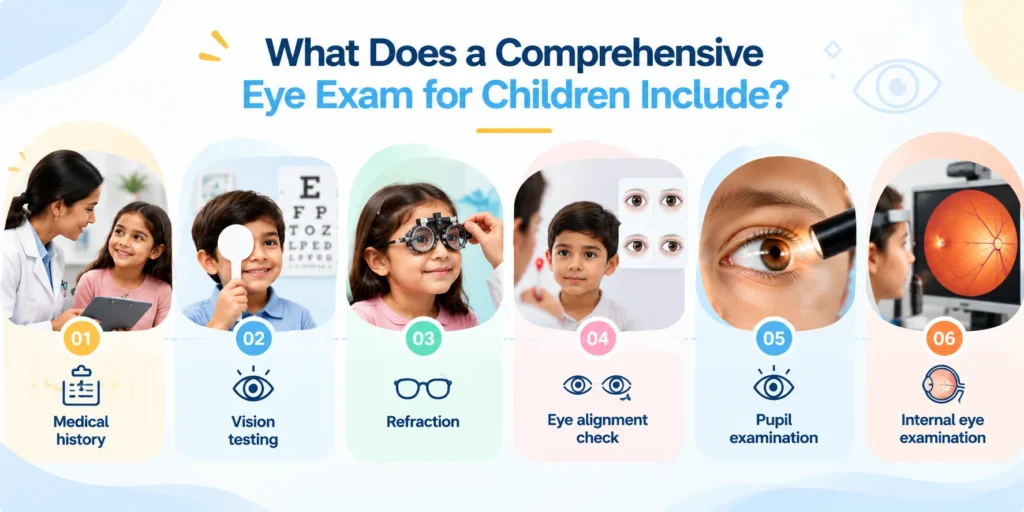
An eye test for kids in Dubai can help parents understand how well their child sees and whether any eye or vision problems need further assessment. A comprehensive eye examination goes beyond reading letters on a chart. Depending on the child’s age, symptoms and medical history, it may include vision testing, refraction, eye alignment checks, pupil examination and an assessment of the internal eye structures.
Children do not always recognise blurred vision or know how to describe it. A child may squint, sit close to a screen or struggle to see the classroom board without realising that their vision needs attention.
At Vasan Eye & Multispeciality DSC in Al Karama, Dubai, paediatric ophthalmology services include assessment of childhood vision concerns, refractive errors, squint and lazy eye. This guide explains what parents can expect during a children’s eye examination, when to arrange one and how to prepare for the appointment.
What Does a Comprehensive Eye Exam for Children Include?
A comprehensive eye examination may involve:
- Medical history: Reviewing symptoms, development, previous eye problems and relevant family history.
- Visual acuity testing: Checking how clearly the child sees with each eye.
- Refraction: Assessing whether glasses may be needed for short-sightedness, long-sightedness or astigmatism.
- Eye alignment and movement tests: Checking whether the eyes move together and point in the same direction.
- Pupil examination: Assessing the pupils and their response to light.
- External eye examination: Looking at the eyelids and visible structures of the eyes.
- Internal eye examination: Examining the retina and optic nerve when indicated, sometimes using dilating drops.
The exact tests depend on the child’s age, ability to cooperate, symptoms and examination findings. Not every child needs every test at every visit.
What Happens During a Child’s Eye Test in Dubai?
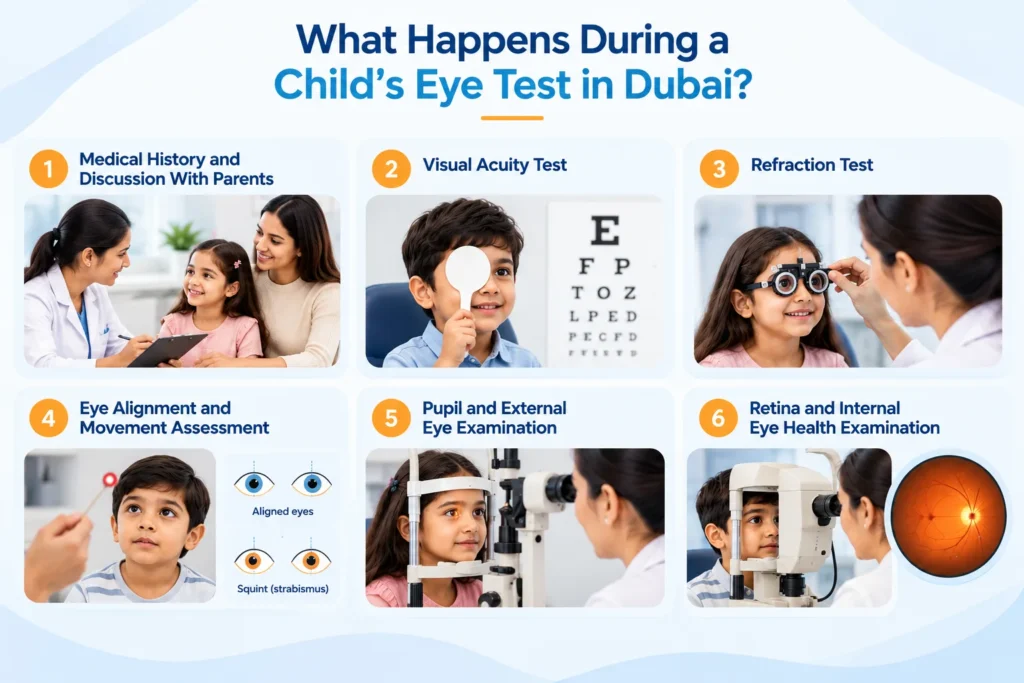
1. Medical History and Discussion With Parents
The appointment usually begins with questions about your child’s vision, general health and development.
The eye specialist may ask whether your child:
- Squints or closes one eye to see more clearly.
- Complains of blurred vision or difficulty seeing distant objects.
- Holds books or screens unusually close.
- Tilts their head while looking at objects.
- Has recurrent eye discomfort, redness or watering.
- Has had an eye injury or previous eye treatment.
- Was born prematurely or has a relevant medical condition.
- Has a family history of squint, lazy eye or significant childhood eye disease.
For younger children, parents’ observations are particularly useful because a child may not be able to explain what they can or cannot see.
2. Visual Acuity Test: How Clearly Can Your Child See?
Visual acuity testing measures how clearly a child can see at a particular distance. Each eye is assessed separately when appropriate.
Older children may read letters or symbols from a chart. Younger children may identify pictures, match shapes or use other age-appropriate methods.
Testing each eye separately can reveal vision differences that may not be obvious in everyday activities.
The results help the specialist decide whether additional tests are needed and whether a refractive error or another vision concern may be present.
3. Refraction Test: Does Your Child Need Glasses?
Refraction testing measures how light focuses in the eye and helps identify refractive errors.
Common examples include:
- Myopia (short-sightedness): Distant objects appear blurred.
- Hyperopia (long-sightedness): Near vision may be difficult, depending on the degree of hyperopia and the child’s focusing ability.
- Astigmatism: Uneven curvature of the cornea or lens can cause blurred or distorted vision.
The specialist may use an instrument to estimate the prescription and then perform additional testing to refine the assessment.
Why might a child need dilating or cycloplegic drops?
Children can actively focus their eyes during testing, which may affect the measurement of their prescription. When clinically appropriate, the specialist uses cycloplegic drops to temporarily relax the focusing muscles.
This can help obtain a more accurate measurement, particularly in younger children. The drops may briefly sting and can cause temporary light sensitivity or blurred near vision.
The specialist determines whether these drops are needed based on the child’s age and clinical findings.
4. Eye Alignment and Movement Assessment
A child may have an eye coordination problem even when they can read a vision chart clearly. The specialist may assess how the eyes move and whether they remain aligned.
Tests may include observing eye movements in different directions and using a cover test to assess alignment.
This assessment can help identify strabismus, commonly called squint, in which the eyes do not point in the same direction. Further evaluation may be needed if the specialist suspects an eye coordination problem or another condition affecting binocular vision.
Parents should mention any occasional eye turn, unusual head posture or tendency to close one eye while looking at objects.
5. Pupil and External Eye Examination
The specialist may examine the pupils, eyelids, conjunctiva, cornea and other visible structures of the eyes.
Pupil assessment includes checking their appearance and response to light. The external examination may help identify signs of irritation, inflammation or other abnormalities.
The tests are adapted to the child’s age and cooperation. A light or specialised instrument may be used to examine the structures more closely.
6. Retina and Internal Eye Health Examination
When indicated, the specialist examines the retina and optic nerve at the back of the eye. This helps assess internal eye health and investigate concerns identified during the earlier tests.
Pupil-dilating drops may be used to provide a better view of the internal structures. After dilation, children may experience temporary light sensitivity and blurred near vision.
Ask the eye-care team whether your child is likely to need dilation and how to prepare for the appointment.
Additional imaging or investigations may be recommended if the initial examination identifies a reason for further assessment.
Eye Screening vs Comprehensive Eye Examination: What Is the Difference?
A school vision screening can be a useful first step, but it does not assess every aspect of eye health.
| Vision screening | Comprehensive eye examination |
| Looks for signs that a child may have a vision problem. | Provides a more detailed assessment of vision and eye health. |
| Usually involves a limited set of tests. | May include refraction, eye alignment, pupil and internal eye examinations. |
| Helps identify children who may need further assessment. | Helps the clinician investigate symptoms and establish a diagnosis when possible. |
| Does not rule out every eye condition. | Is recommended when symptoms, risk factors or screening results warrant further evaluation. |
The American Academy of Ophthalmology advises a comprehensive eye examination when a child fails a screening, cannot complete screening reliably, has visual symptoms or has relevant risk factors.
A child who passes a vision screening may still need a comprehensive examination if parents or a healthcare professional have concerns.
At What Age Should a Child Have an Eye Test?
The appropriate timing depends on the child’s age, development, symptoms and risk factors. Routine screening and comprehensive eye examinations serve different purposes, so there is no single schedule that applies to every child.
| Age or situation | What parents should know |
| Newborns and infants | Routine health checks include assessment of basic eye health. A comprehensive examination may be needed if there are signs of an eye problem, prematurity or significant risk factors. |
| Toddlers and preschool children | Age-appropriate screening can help identify risk factors for reduced vision. Picture-based tests or instrument-based screening may be used. |
| School-age children | Vision screening can identify possible problems, while symptoms or a failed screening may require a comprehensive examination. |
| Children with symptoms or known risk factors | Arrange an assessment based on clinical advice rather than waiting for the next routine screening. |
For detailed age-based recommendations, refer to the American Academy of Ophthalmology’s guidance on paediatric eye evaluations.
What Eye Problems Can a Comprehensive Examination Identify?
Depending on the tests performed, a comprehensive examination may help identify or investigate:
- Refractive errors: Myopia, hyperopia and astigmatism.
- Squint (strabismus): Misalignment of the eyes.
- Lazy eye (amblyopia): Reduced vision in one or both eyes associated with abnormal visual development.
- Focusing difficulties: Problems that may affect how the eyes focus on near or distant objects.
- Eye surface concerns: Signs of irritation, inflammation or other visible abnormalities.
- Other eye conditions: Findings that may require additional investigation.
The presence of a symptom does not automatically confirm a diagnosis. The specialist interprets the examination findings together and recommends further testing or treatment when needed.
Signs Your Child May Need an Eye Examination
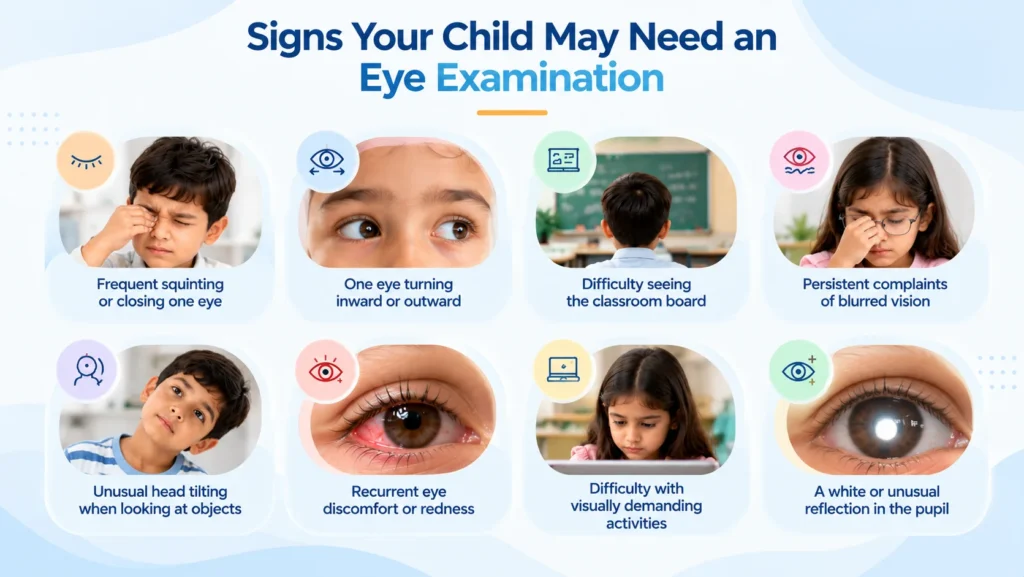
Consider arranging an eye assessment if you notice:
- Frequent squinting or closing one eye.
- One eye turning inward or outward.
- Difficulty seeing the classroom board.
- Persistent complaints of blurred vision.
- Unusual head tilting when looking at objects.
- Recurrent eye discomfort or redness.
- Difficulty with visually demanding activities.
- A white or unusual reflection in the pupil.
These signs can have different causes and do not always indicate a serious condition. However, they should be discussed with an eye-care professional.
Seek urgent medical assessment for sudden changes in vision, severe eye pain, a significant eye injury or a new white pupil reflection. Do not wait for a routine appointment if symptoms are sudden or severe.
How Can Parents Prepare for a Child’s Eye Test?
A little preparation can help the visit run more smoothly.
Before the appointment:
- Explain the visit simply. Tell your child that the doctor will check how their eyes work.
- Bring their glasses. If your child already wears glasses, take them to the appointment.
- Carry previous records. Bring earlier eye-test reports, prescriptions and relevant medical information.
- Note the symptoms. Record when you first noticed the problem and whether it occurs during reading, screen use or outdoor activities.
- Share medical and family history. Tell the specialist about relevant conditions, medicines and family eye problems.
- Ask about dilating drops. Confirm whether any preparation is needed and whether you should bring sunglasses for the journey home.
Children do not need to memorise an eye chart beforehand. The specialist can select an appropriate testing method based on their age and ability to cooperate.
Where Can You Get an Eye Test for Kids in Dubai?
Parents looking for a children’s eye check-up in Dubai can consult an eye-care service that assesses both vision and eye health.
Vasan Eye & Multispeciality DSC provides paediatric ophthalmology services for childhood vision concerns, including refractive errors, squint and lazy eye.
You can learn more about the available services on the Vasan Eye paediatric ophthalmology page. Contact the clinic to confirm appointment availability and which examination is appropriate for your child.
Book an Eye Examination for Your Child in Dubai
If you have concerns about your child’s vision, an eye assessment can help determine whether further testing or treatment is needed.
Vasan Eye & Multispeciality DSC in Al Karama, Dubai, offers paediatric ophthalmology services for childhood vision concerns, including refractive errors, squint and lazy eye.
Location: Zabeel Plaza, Zabeel Road, Al Karama, Dubai, UAE.
Book an appointment with Vasan Eye or contact the clinic to confirm appointment availability and the appropriate examination for your child.
Medical review: Add the name, verified credentials and review date of the clinician who reviews and approves this article before publication.
References:
- American Academy of Ophthalmology (AAO). Pediatric Eye Evaluations Preferred Practice Pattern.
- American Academy of Ophthalmology (AAO). Vision Screening for Infants and Children.
- American Association for Pediatric Ophthalmology and Strabismus (AAPOS). Vision Screening Recommendations.
- American Association for Pediatric Ophthalmology and Strabismus (AAPOS). Refractive Errors in Children.
- American Association for Pediatric Ophthalmology and Strabismus (AAPOS). Amblyopia (Lazy Eye).
- American Association for Pediatric Ophthalmology and Strabismus (AAPOS). Strabismus (Crossed Eyes).