

PRK Eye Surgery in Dubai
In recent times, there has been a significant increase in the cases of refractive disorders. These conditions visually impair more than 2 billion people globally, adversely affecting their lives. Among these, myopia or nearsightedness stands as the most prevalent and untreated condition, as per the World Health Organisation’s report. With numerous remedy options being available globally, PRK eye surgery in Dubai remains significantly the safest and most effective option for a comprehensive treatment. Most patients prefer standard options like corrective eyeglasses and contact lenses to temporarily deal with their vision problems. However, there are surgical, reshaping, and lens-based remedies that are also opted for a more convenient management of the conditions.
Photorefractive Keratectomy (PRK) is a commonly selected surgical method for the correction of these disorders. Even though there are various corrective remedies accessible around the world for these conditions, the number of patients seeking treatment remains immensely low due to the complexity of geographical, financial, and cultural hindrances. Refractive eye surgery in Dubai suggests a holistic option for patients seeking a modern and successful remedy.
At Vasan Eye & Multispeciality Day Surgical Center, we provide the best refractive treatment with our specialised doctors who prioritise your recovery at every step. Book an appointment today to get assistance.
Understanding the PRK Eye Surgery
Everything you need to know
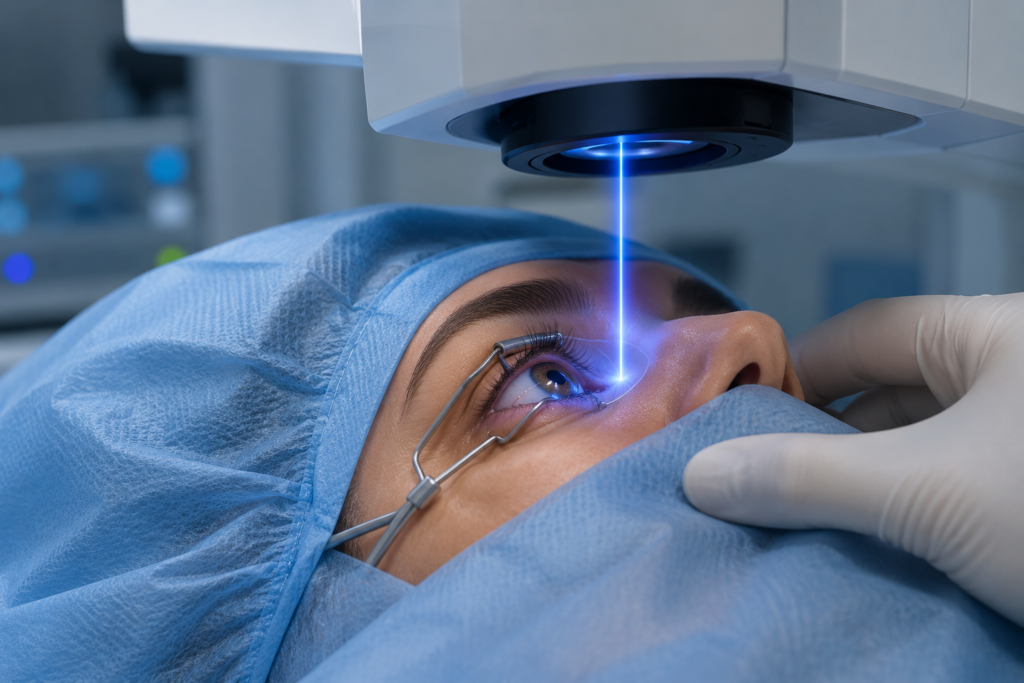
PRK, which stands for Photorefractive Keratectomy, is a surgical vision-correcting procedure. It uses laser technology to alter the eye of the patients dealing with refractive conditions, such as myopia (nearsightedness), hyperopia (farsightedness), astigmatism, and presbyopia. The goal of this treatment is to reduce an individual’s dependency on eyeglasses and contact lenses.
In PRK surgery, the shape of the cornea, the clear, outermost layer of the eye, is corrected. This makes the light refract better, allowing individuals to improve the quality of their vision. This procedure is performed by trained ophthalmologists with extensive expertise in treating multiple eye-related conditions. Recently, alternative processes like LASIK have become relatively popular due to their feasibility. However, PRK is still widely employed in conditions where newer technologies are not feasible to apply to the patients.
Meet Our Specialist
Vasan Eye Dubai

Dr. Umesh Patinjarekandy
Specialist Ophthalmologist | Phaco & Refractive Surgeon
MBBS, MS Ophthalmology
location_on Vasan Eye & Multispeciality Day Surgical Center, Dubai
schedule 30+ Years of Experience
medical_services 25000+ Surgeries Performed

Dr. Tahere Rezaei
Specialist Ophthalmologist | Cataract & Refractive Surgeon
MBBS, MD Ophthalmology
location_on Vasan Eye & Multispeciality Day Surgical Center, Dubai
schedule 11+ Years of Experience
medical_services 10000+ Surgeries Performed

Dr. Lakshmi K. Vijayaraghavan
Specialist Ophthalmologist | Medical Retina Specialist
MBBS, MS (Ophthalmology), Fellowship in Medical Retina & ROP
location_on Vasan Eye & Multispeciality Day Surgical Center, Dubai
schedule 7+ Years of Experience
Dr. Nikhil Pal
Specialist Ophthalmologist | Retina & Uvea Specialist
MBBS, MD Ophthalmology (AIIMS, New Delhi, India), Vitreoretina Fellow (Univ Of Wisconsin, Madison, USA)
location_on Vasan Eye & Multispeciality Day Surgical Center, Dubai
schedule 25+ Years of Experience
medical_services 20000+ Surgeries Performed
Are there Any Risks?
Understanding the risks of PRK eye surgery
Even though the PRK eye surgery is a safe process, there still might be a few side effects or complications that a patient may experience after the surgery. These risks include:
- Dryness in the eyes
- Sensitivity to light
- Slight irritation and discomfort
- Incomplete or blurry vision
- Starbursts around the lights
- Temporary blurry appearance of the cornea
- Infections may also occur rarely
- Delayed restoration of complete vision
When is a PRK Eye Surgery Required?
When PRK Eye Surgery May Be Recommended
A PRK surgery becomes a necessity when a patient wants to undergo permanent vision correction. Even though LASIK has been used recently, it cannot be performed in certain conditions. This is where PRK comes in and serves as an important procedure.
Some of the conditions in which PRK is performed are:
- As the PRK surgery does not make an incision and moulds the cornea into a flap, it is usually recommended for people who have thinner corneas.
- People who are athletes, have an active routine, and are engaged in contact sports are generally recommended to undergo PRK to prevent the risk of any serious injuries.
- People who acquire an irregular corneal shape are also treated with PRK for minimal risk.
- PRK is selected for cases ranging from mild to moderate refractive errors to avoid the risk of any complications.
- People who have dry eyes are also treated with PRK instead of LASIK.
PRK vs LASIK
What is the difference?
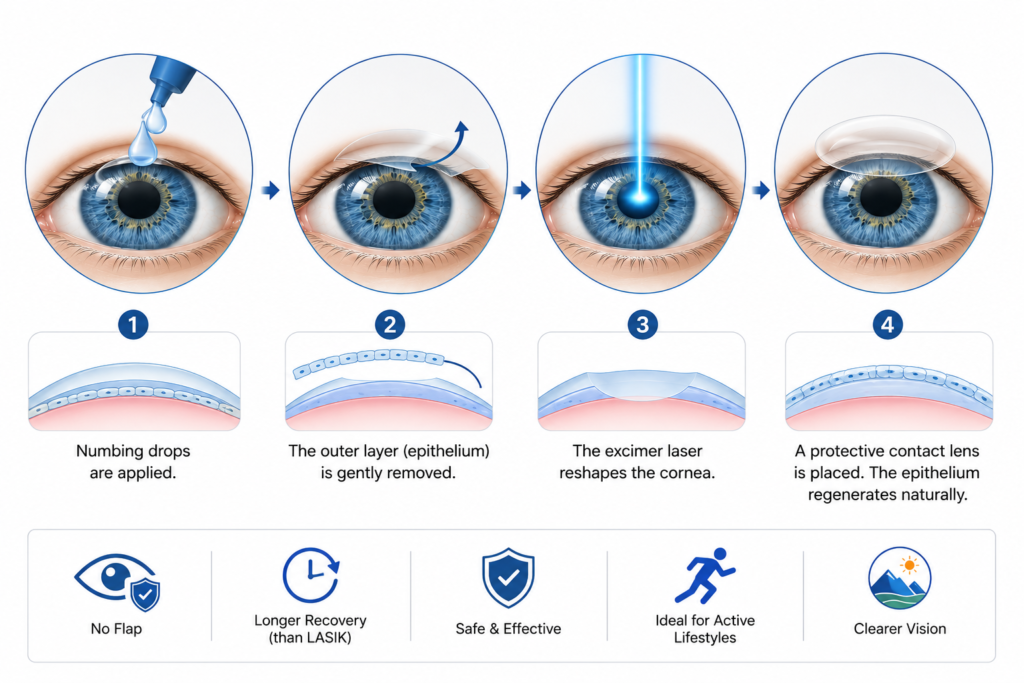
Even though both PRK and LASIK are laser-based surgical procedures, they are usually applied according to the characteristics and health of the patient. The primary distinction is that PRK removes the outer layer of the cornea, called the epithelium, before reshaping the cornea. In contrast, LASIK creates a thin flap in the cornea that is lifted and repositioned after the reshaping. Since PRK does not involve creating a flap, it is often recommended for patients with thin corneas or those who play contact sports.
LASIK typically offers faster visual recovery and less discomfort. Many patients notice improved vision within 24 to 48 hours. PRK, however, has a longer healing period because the epithelium needs time to grow back. While PRK patients may feel more discomfort during the early recovery phase, both procedures provide similar long-term vision correction results when done on appropriate patients.
PRK Procedure: Step by Step
What to expect during the processs
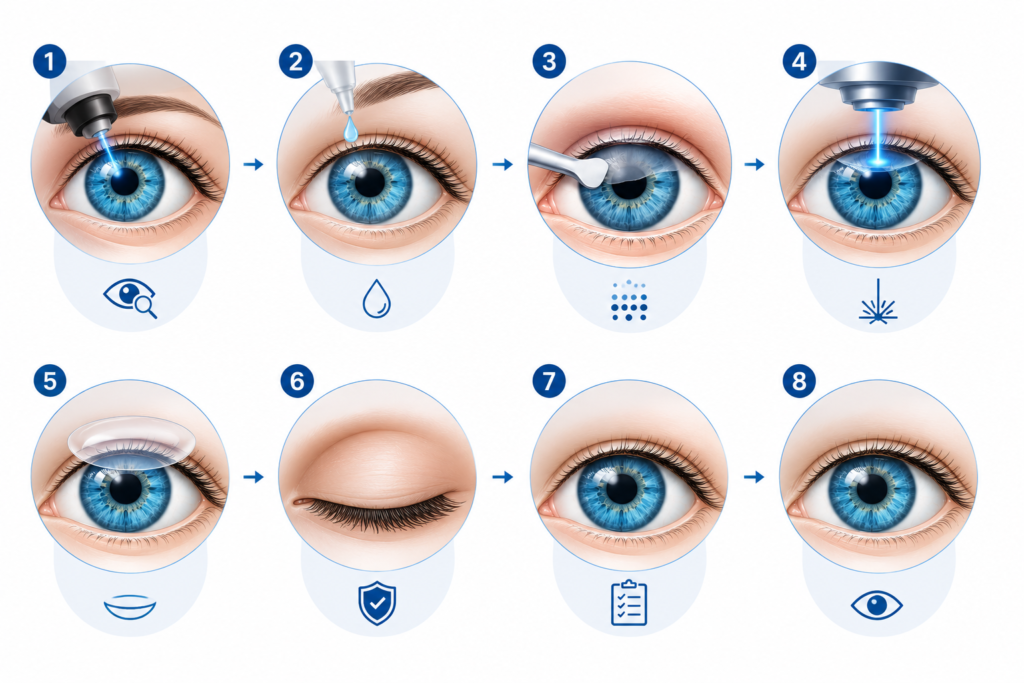
The PRK procedure usually follows multiple stages during the surgery. These steps are:
- Complete eye examination: The initial process of the treatment is the initial appointment with the eye specialist, who assesses the condition of the patient and suggests the appropriate method. The ophthalmologist then properly examines the condition of the patient’s eye to check the suitability for conducting the PRK surgery.
- Applying numbing eye drops: The surgical process generally starts with applying anaesthetic eye drops to the patients to minimise any pain that they might experience.
- Removing the corneal epithelium: The ophthalmologist then gently removes the outer corneal epithelium to expose the area in which the treatment has to take place.
- Laser reshaping of the cornea: Then, using a laser, the cornea is reshaped to correct the refractive error and improve the quality of the patient’s vision.
- Applying a protective bandage: A protective bandage lens is put on the surgical area to protect it.
- Recovery and healing: The outer protective area, or the epithelium, then heals gradually.
- Follow-up: After the eye heals in a few days, follow-up appointments with the doctor are again conducted with the physician to assess the current condition of the patient.
- Vision restoration: As the cornea gradually heals itself over the weeks, the patient finally restores their complete vision.
Why Choose Vasan Eye & Multi Speciality for PRK Eye Surgery in Dubai?
Advanced PRK Treatment with Personalized Care.
An advanced and successful refractive error treatment in Dubai is why most global patients prefer Dubai for their visual surgery. Dubai offers a variety of technologically advanced facilities, such as laser procedures. Apart from the modern technology, highly experienced and qualified ophthalmologists are also the reason why patients choose to travel to Dubai to receive their treatment. Dubai also has a wide variety of internationally recognised and accredited eye clinics, and is also an affordable option for patients from most countries. The availability of multilingual staff with a strong prioritisation of patient safety and comfort makes it a distinct medical treatment location.
Dubai also possesses a strong reputation in the Middle Eastern areas due to its strong infrastructure and access to modern medical technology. Lastly, the focus on personalised assessment and quality care provided here makes it a truly distinguished location for multiple eye conditions.
Patients across the globe choose Vasan Eye & Multispeciality DSC for PRK eye surgery in Dubai for multiple reasons, such as:
- Experienced Eye Specialists
- State-of-the-Art Eye Care Facilities
- Comprehensive Eye Care Services
- Personalised Treatment Programs
- Patient-Focused Approach
Frequently Asked Questions
PRK Eye Surgery in Dubai
Is PRK eye surgery in Dubai painful? expand_more
PRK surgery is usually not painful because the numbing eyedrops are applied to the patient’s eye to ease any pain that they might experience during the process. However, the patient may still experience a slight irritation or discomfort after the surgery. They may also feel sensitive to light while the cornea heals itself with time.
How long does it take to recover from PRK surgery? expand_more
After surgery, initial healing takes place around 3-5 days, during which the corneal epithelium heals and regenerates. Patients can resume their routine activities after a week, and the vision improves gradually with time.
How much does PRK surgery cost in Dubai? expand_more
The average PRK surgery cost in Dubai ranges from AED 4,000 to AED 10,000, which approximately equals about $1,100 to $2,700 USD. However, it may vary depending on the expertise of the ophthalmologist, type of clinic, accommodation cost, personal preferences, type of technology employed and travel expenses.
Is PRK riskier than LASIK? expand_more
PRK is not considered riskier than LASIK. It may take a longer time for the patient to recover and heal after PRK than after LASIK, but both procedures are generally considered safe if conducted by a specialised and experienced medical professional.
Can type 2 diabetes have laser eye surgery? expand_more
Yes, patients with type 2 diabetes qualify for a PRK eye surgery only if their blood sugar levels are well-balanced, they do not have a chronic eye disorder and are overall healthy. The ophthalmologist conducts a full examination before the surgery to check for any complications beforehand.
How long does the PRK procedure take? expand_more
The PRK surgery procedure usually takes a few minutes per eye. It should also be noted that the whole process takes around 1-2 hours, depending on the patient's health and the requirements of the surgery.