


Cornea Transplant in Dubai
Trusted Destination For Healthy Vision
A cornea transplant is a surgical procedure that replaces a damaged or diseased cornea with healthy donor tissue to restore vision and reduce discomfort. At Vasan Eye, cornea transplant in Dubai is a trusted treatment option, offering advanced corneal care, experienced specialists, and personalised support throughout the patient’s treatment journey.
As per the Indiana Donor Network, corneal transplantation holds the highest success rate among all human tissue or organ transplants due to the cornea's natural immune privilege. In optimal, low-risk cases, cornea transplants can achieve up to a 95% graft survival rate.
The organisation also notes that this highly effective procedure has restored sight to over 2.4 million people worldwide since 1961, supported by modern layered surgical techniques that help reduce immune rejection risks.
What is a Cornea Transplant?
How Cornea Transplant Restores Vision
A cornea transplant surgery is an operation that involves replacing your affected cornea with healthy donor corneal tissue. Your cornea is the clear, domed-shaped surface of your eye that allows light rays to pass through into your eye, hence enabling you to see things clearly.
Once your cornea becomes opaque, swollen, scarred, or malformed, you will have difficulties carrying out everyday activities such as reading, driving, and even recognizing faces.
Cornea transplants are carried out to help you regain your sight, relieve eye pain, and make your eye healthy again. In cases where your eye doctor finds out that there is something wrong with your cornea, he or she can decide either to remove your whole cornea or just the affected portion.
Types of Cornea Transplant
Choosing the Right Cornea Transplant
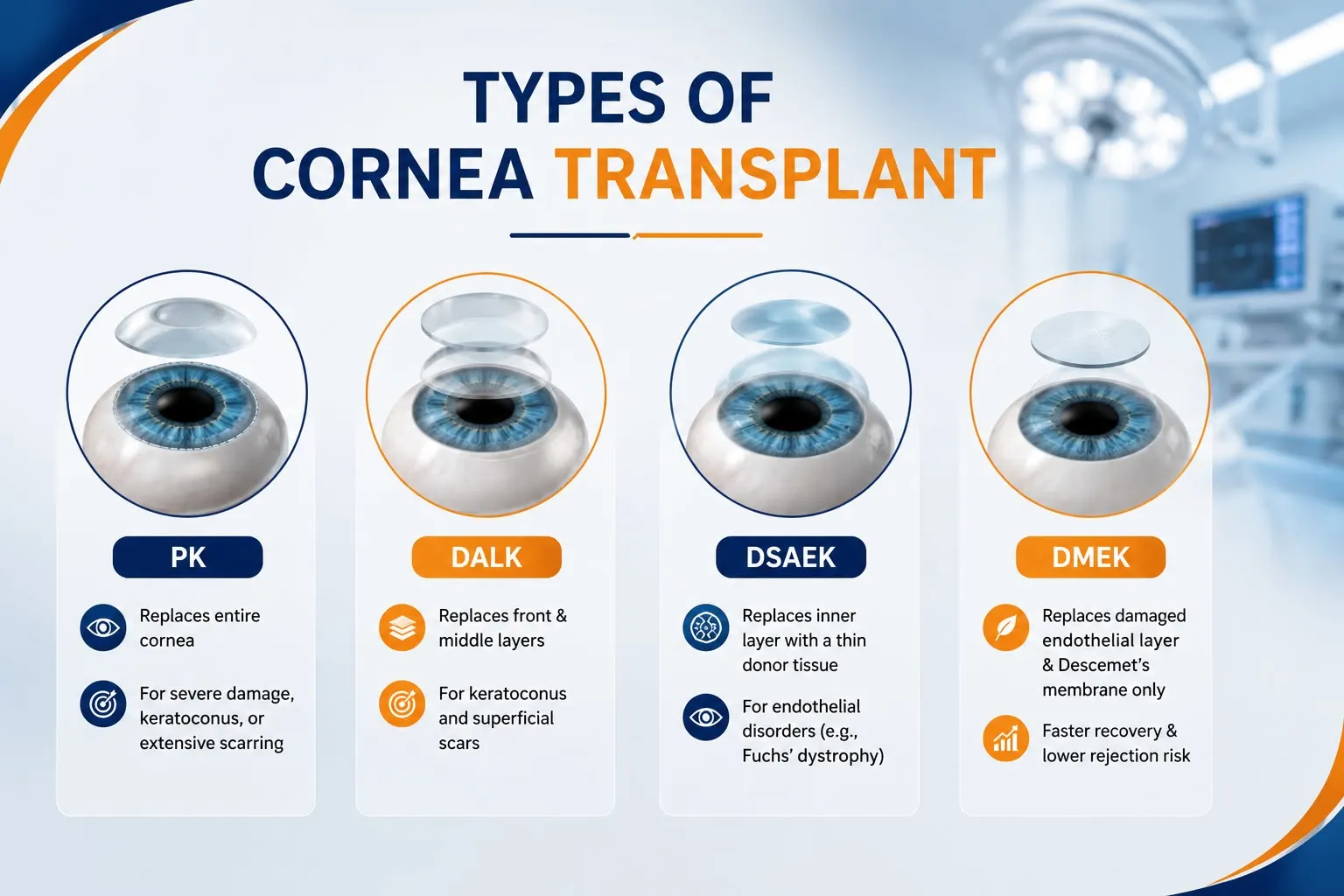
There are four main types of corneal transplants, each designed to treat damage to a specific layer of the cornea. Based on the results of your eye examination, your ophthalmologist may recommend one of the following procedures:
- Penetrating Keratoplasty (PK): Replaces the entire cornea and is recommended for severe corneal damage, advanced keratoconus, or extensive scarring.
- Deep Anterior Lamellar Keratoplasty (DALK): Replaces the front and middle layers of the cornea while preserving the healthy inner layer. It is commonly used for keratoconus and superficial corneal scars.
- Descemet's Stripping Automated Endothelial Keratoplasty (DSAEK): Replaces the damaged inner layer of the cornea with a thin layer of donor tissue. It is often recommended for endothelial disorders such as Fuchs' dystrophy.
- Descemet Membrane Endothelial Keratoplasty (DMEK): Replaces only the diseased endothelial layer and Descemet's membrane. This minimally invasive technique may provide faster visual recovery and a lower risk of graft rejection in suitable patients.
What is the Need for a Cornea Transplant?
Conditions Requiring Corneal Transplant
Corneal transplants are generally considered in cases where the cornea is so affected by problems that no corrective measures like glasses, contact lenses, eye drops, or other treatment modalities can improve your condition anymore.
In general, a corneal transplant procedure seeks to restore clarity in vision, relieve discomfort, and enable you to resume your day-to-day activities easily. An eye specialist in Dubai would suggest corneal transplants if you have one of the following:
- Blurry or distorted vision because of the damaged cornea.
- Keratoconus is a condition wherein the cornea is thin and bulging outward.
- Fuchs' endothelial dystrophy is when the cornea swells up and gets cloudy.
- Corneal scars resulting from an eye injury, infection, or surgery.
- Unhealed corneal ulcers that don't respond to medication.
- Corneal swelling that affects vision and causes pain.
- Thinning or tearing of the cornea.
You should consult an eye specialist if you experience persistent blurred vision that doesn't improve with glasses, eye pain, redness or irritation, increased sensitivity to light, a sensation of something in your eye, or vision changes after an eye injury or infection.
Cornea Transplant: The Complete Process
From Diagnosis to Recovery
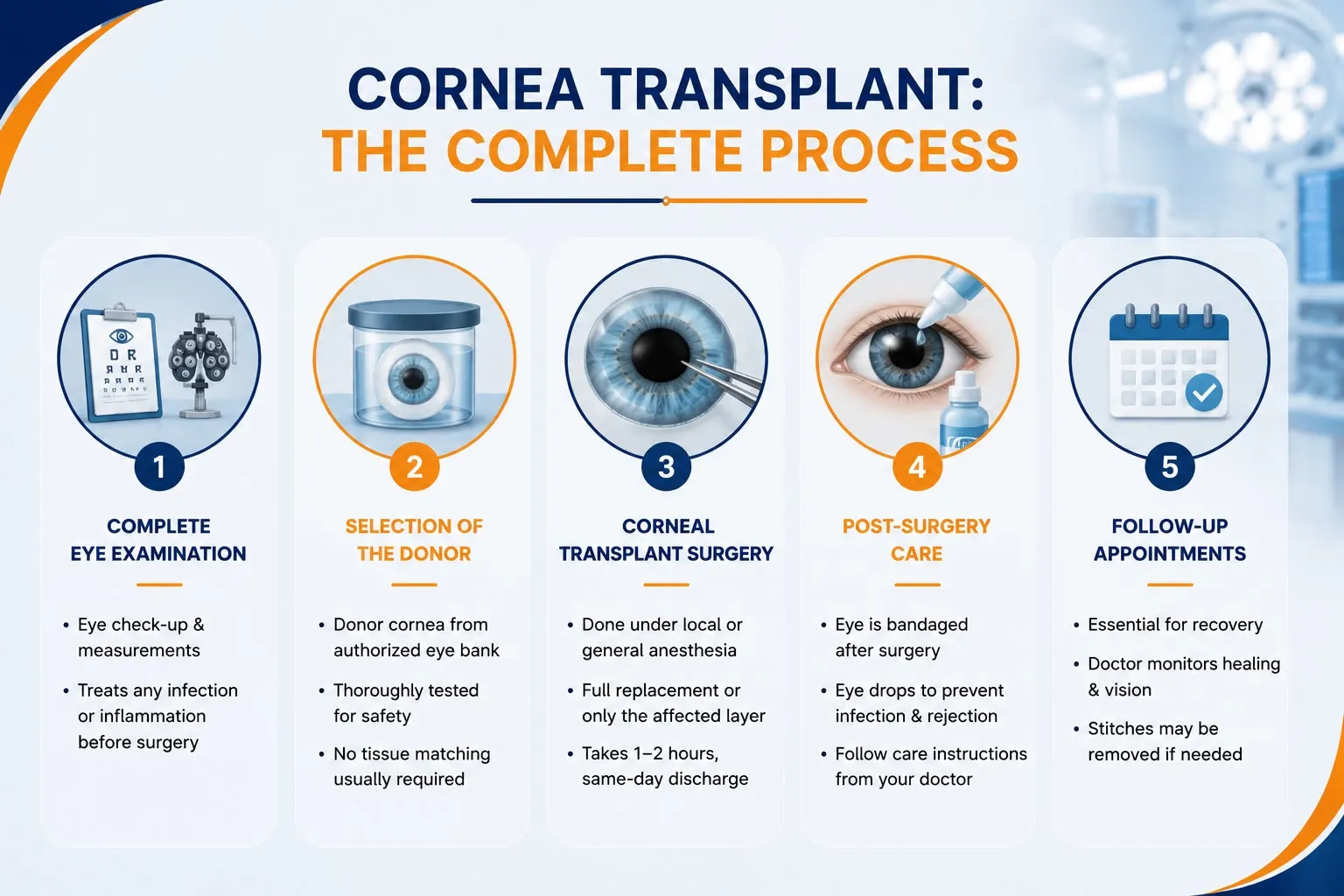
Corneal transplant is a highly planned process aimed at replacing the unhealthy tissue of the cornea with healthy tissue and improving your vision. Although the specific method of transplantation varies depending on the eye problem you have, the typical stages include the following:
Complete Eye Examination
- Your eye specialist will assess your vision and the state of your cornea, analyze your medical history, and conduct eye measurements.
- In case there are any problems with eye infection and/or inflammation, they will be successfully treated before the transplantation.
Selection of the Donor
- Healthy corneal tissue is provided by an authorized eye bank.
- All donor corneas go through a careful testing process that confirms their safety and appropriateness for transplant.
- Contrary to many other organ transplants, corneal transplantation does not usually imply tissue matching.
Corneal Transplant Surgery
- Most corneal transplant surgeries take place under local or general anesthesia, meaning that you will not feel any pain while undergoing the procedure.
- Depending on the problem with your cornea, your doctor might perform a full replacement or replace the layer of your cornea that is affected by the disease.
- Most surgeries last from one to two hours, and many patients leave the hospital on the same day after the surgery.
Post-Surgery Care
- After the surgery, the eye will be bandaged right after the operation.
- Your eye specialist will prescribe eye drops to prevent infections and avoid graft rejection.
- Moreover, you will get instructions about taking care of your eye after the surgery.
Follow-Up Appointments
- Follow-up appointments are an important component of your recovery process.
- Your ophthalmologist will facilitate your healing process, check your eyesight, and monitor the function of the transplanted cornea.
- Sometimes, if you have undergone a full-thickness corneal transplant, your stitches can be removed during follow-up visits.
Risks Associated With Cornea Transplant
Possible Post-Surgery Complications
Cornea transplant surgery is generally safe and successful, but potential risks include:
- Corneal graft rejection
- Eye infection
- Increased eye pressure (glaucoma)
- Bleeding inside the eye
- Cataract formation
- Swelling of the cornea
- Problems with stitches or wound healing
Seek immediate medical attention if you experience:
- Sudden blurred or reduced vision
- Eye pain
- Persistent redness
- Increased sensitivity to light
Recovery After Cornea Transplant Surgery
Post-Surgery Care Tips
Recovery after a cornea transplant is gradual, and following your ophthalmologist's instructions plays an important role in achieving the best possible results. During your recovery, you should:
- Use your prescribed eye drops as directed.
- Wear a protective eye shield, especially while sleeping.
- Avoid rubbing or putting pressure on your eye.
- Avoid heavy lifting, strenuous exercise, and swimming until advised.
- Attend all follow-up appointments to monitor healing.
- Contact your eye specialist immediately if you notice worsening vision, eye pain, redness, or increased sensitivity to light.
Your Cornea Transplant Journey at Vasan Eye Dubai
Expert Cornea Care at Vasan Eye
From accurate diagnosis to recovery, Vasan Eye & Multispeciality DSC provides comprehensive cornea care with advanced treatment and personalised support, including:
- Comprehensive Cornea Evaluation – Accurate diagnosis with advanced eye tests.
- Expert Cornea Specialists – Personalised treatment plans for your condition.
- Advanced Cornea Transplant Surgery – Modern techniques for precise and effective treatment.
- Dedicated Day Surgical Centre – Convenient care with faster recovery.
- Post-Operative Care – Regular follow-ups and recovery guidance.
- Insurance Accepted – Cashless assistance for eligible patients.
- Multilingual Patient Support – Clear communication throughout your treatment journey.
Frequently Asked Questions
Everything you need to know
Why would someone need a cornea transplant? expand_more
A cornea transplant may be recommended when the cornea becomes scarred, swollen, or damaged due to conditions such as keratoconus, Fuchs' dystrophy, eye infections, or injury. When the cornea can no longer focus light properly, it can cause blurred vision, pain, and other symptoms that cannot be treated with glasses, contact lenses, or medication. Replacing the damaged cornea with healthy donor tissue can help restore vision, relieve discomfort, and improve your quality of life.
Is an artificial cornea transplant safe? expand_more
An artificial cornea transplant may be considered for patients who are not suitable candidates for a donor cornea transplant or when previous corneal transplants have not been successful. Although it eliminates the risk of donor tissue rejection, it carries a higher risk of complications such as infection, glaucoma, and implant-related problems. Patients require lifelong follow-up care, regular use of prescribed medications, and continuous protective measures to maintain the health and function of the artificial cornea.
How successful is a cornea transplant? expand_more
The American Academy of Ophthalmology (AAO) reports a 90%–95% success rate in the first year following corneal transplant surgery. For diseases like keratoconus, long-term results are especially favorable, with 92%–97% of grafts still being effective after five years. The type of transplant, the underlying eye problem, and adherence to your ophthalmologist's post-operative care instructions all affect the outcome.
What is the average cornea transplant cost in Dubai? expand_more
The cost of a cornea transplant in Dubai varies depending on factors such as the type of transplant, the complexity of your eye condition, the surgeon's expertise, the hospital, and whether donor tissue or additional treatments are required. A detailed eye examination is necessary to determine the most appropriate procedure and provide an accurate cost estimate.
How to find the best cornea transplant surgeon in Dubai? expand_more
When choosing a cornea transplant surgeon in Dubai, look for extensive experience in corneal procedures, advanced diagnostic and surgical technology, and comprehensive pre- and post-operative care. At Vasan Eye & Multispeciality DSC, experienced cornea specialists provide personalised treatment, advanced cornea transplant techniques, and dedicated support throughout your journey—from diagnosis to recovery.
How to find the best hospital for an eye cornea transplant? expand_more
Select a facility that has access to high-quality donor corneal tissue, skilled cornea experts, cutting-edge diagnostic and surgical technology, and thorough pre- and post-operative care. The greatest results can be ensured by a facility with a solid reputation for corneal transplants and individualized patient care. Patients at Vasan Eye & Multispeciality DSC get professional corneal care, cutting-edge treatment options, and committed support during their course of treatment and recuperation.
How to book an appointment at Vasan Eye Care Dubai? expand_more
Booking an appointment at Vasan Eye & Multispeciality DSC is quick and convenient. You can schedule your consultation online through the appointment booking page, call the clinic, send a WhatsApp message, or visit the hospital in Al Karama to book an appointment with one of our experienced eye specialists. Vasan Eye & Multispeciality DSC also offers personalised assistance to help you find a suitable consultation time.
What is the cornea reflex? expand_more
The corneal reflex is an automatic blinking response that helps protect the eye from injury. When the cornea is touched or irritated by dust or other foreign particles, the trigeminal nerve (cranial nerve V) sends a signal to the brainstem, which immediately activates the facial nerve (cranial nerve VII) to close both eyelids. Doctors often assess the corneal reflex to evaluate brainstem function, cranial nerve health, and a patient's level of consciousness.
What is corneal or ocular eye disease? expand_more
Corneal and ocular eye diseases are conditions that affect the eyes and can impair vision. While ocular disease refers to any disorder affecting the eye or visual system, corneal disease specifically affects the cornea-the clear front surface of the eye.
What are the symptoms of a thin cornea? expand_more
A thin cornea may not cause symptoms initially, but as it progresses, it can lead to blurred or distorted vision, frequent changes in glasses prescription, increasing short-sightedness, difficulty seeing at night, light sensitivity, glare, and eye strain. A comprehensive eye examination can detect corneal thinning early and help prevent further vision problems.
When should I seek a cornea transplant in Dubai? expand_more
You may need a cornea transplant if corneal damage causes severe vision problems, pain, or discomfort that cannot be improved with glasses, contact lenses, or medicines. Conditions such as keratoconus, Fuchs' dystrophy, corneal scarring, and corneal thinning may require evaluation by a cornea specialist.
What are corneal eye diseases? expand_more
Corneal eye diseases are conditions affecting the cornea, the clear front layer of the eye responsible for focusing light. They can cause clouding, swelling, scarring, or changes in corneal shape, leading to blurred vision, discomfort, and light sensitivity. Common examples include keratoconus, Fuchs' dystrophy, corneal infections, and corneal scarring.