
Types of Cataract Lens Implants: Which Lens Is Right for You?
Choosing a lens implant is an important part of cataract surgery. While the procedure removes the cloudy natural lens of the eye, the artificial lens that replaces it helps determine how clearly you see at different distances after surgery. With several options available, understanding the types of cataract lens implants can help you make a more informed decision.
Some lenses are designed to provide clear distance vision, while others aim to improve vision at near and intermediate distances or correct astigmatism. The right choice depends on your eye health, daily activities, visual expectations and whether you are comfortable wearing glasses for certain tasks.
At Vasan Eye & Multispeciality Day Surgical Centre in Dubai, patients can discuss different intraocular lens (IOL) options with an eye specialist and understand which may be suitable for their individual needs.
What Are Cataract Lens Implants?
A cataract develops when the natural lens inside the eye becomes cloudy, causing blurred vision, glare, faded colours or difficulty seeing clearly in low light. During cataract surgery, the cloudy lens is removed and replaced with an artificial lens called an intraocular lens (IOL).
An IOL helps focus incoming light onto the retina, allowing you to see more clearly. The lens has a specific optical power, which is calculated using measurements of your eye before surgery.
Different IOLs have different focusing designs. Some provide vision at one primary distance, while others offer a broader range of vision or correct refractive errors such as astigmatism.
What Are the Different Types of Cataract Lens Implants?
The main types of cataract lens implants include monofocal, multifocal, trifocal, extended depth-of-focus (EDOF) and toric lenses. Each offers different benefits and limitations.
1. Monofocal IOLs
Monofocal lenses are designed to provide clear vision at one primary distance. Most are set for distance vision, helping patients see television, recognise faces and navigate their surroundings more comfortably.
However, reading, using a mobile phone or performing other close-up tasks may still require glasses.
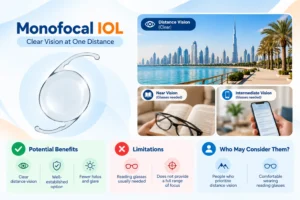
Potential benefits:
- Clear vision at the selected focal distance.
- A well-established option for cataract surgery.
- Generally fewer issues with halos and glare than multifocal lenses.
- Suitable for many patients, including some with additional eye conditions.
Limitations:
- Usually require reading glasses when set for distance vision.
- Do not independently provide the same range of focus as multifocal or trifocal lenses.
Who may consider them?
Monofocal lenses may suit people who prioritise distance vision, are comfortable wearing reading glasses or prefer a straightforward lens option. They can also be considered when certain eye conditions make other lens designs less suitable.
2. Multifocal IOLs
Multifocal lenses are designed to provide more than one focal point, helping patients see at different distances. Depending on the lens design, they may support both near and distance vision, with some options also providing intermediate vision.
For example, a patient may find it easier to read a book, check a phone and look across a room without changing glasses as frequently.
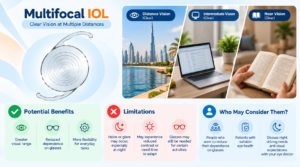
Potential benefits:
- Greater visual range than a conventional monofocal lens.
- Reduced dependence on glasses for selected daily activities.
- May suit patients who want more flexibility when reading and performing everyday tasks.
Limitations:
- Halos or glare around lights may occur, particularly at night.
- Some patients experience reduced contrast or need time to adapt.
- Glasses may still be needed for certain activities.
Who may consider them?
Multifocal lenses may suit patients who want to reduce their dependence on glasses and have eye health suitable for this type of implant. Night-driving requirements, retinal health and visual expectations should be discussed before making a decision.
3. Trifocal IOLs
Trifocal lenses are designed to provide three main ranges of vision: near, intermediate and distance.
Near vision supports activities such as reading. Intermediate vision is useful for computer work and viewing objects at arm’s length, while distance vision helps with activities such as watching television or recognising people across a room.
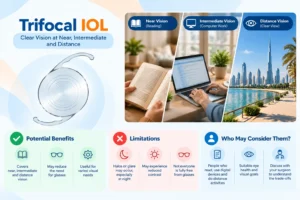
Potential benefits:
- Designed to cover near, intermediate and distance vision.
- May reduce the need for glasses for many routine activities.
- Can be useful for people with varied visual requirements throughout the day.
Limitations:
- Halos, glare and reduced contrast may affect some patients.
- Not everyone achieves the same level of spectacle independence.
- Careful assessment is needed to determine suitability.
Who may consider them?
Trifocal lenses may be worth discussing if you regularly read, use digital devices and perform distance activities, and you would prefer to rely less on glasses. Your surgeon will assess your eye health and explain the likely visual trade-offs.
4. Extended Depth-of-Focus (EDOF) IOLs
Extended depth-of-focus lenses are designed to extend the range over which vision remains clear, particularly from distance to intermediate range. Depending on the lens design, they may also provide some useful near vision.
These lenses may be an option for people who spend considerable time working on computers, using digital devices or carrying out tasks that require intermediate vision.
Potential benefits:
- Extended range of focus, particularly for distance and intermediate tasks.
- May reduce dependence on glasses for computer use and other everyday activities.
- Some designs may produce fewer bothersome visual disturbances than certain multifocal lenses, although this varies.
Limitations:
- Reading small print may still require glasses.
- Visual outcomes and night-time symptoms vary by lens design and patient.
- They are not suitable for everyone.
Who may consider them?
EDOF lenses may suit patients who want a broader range of vision without necessarily prioritising complete spectacle independence for reading. The precise performance depends on the particular lens and the patient’s visual requirements.
5. Toric IOLs
Toric lenses are designed to correct corneal astigmatism, a refractive error caused by an uneven curvature of the cornea. Astigmatism can make vision blurred or distorted at different distances.
A toric IOL can address cataracts and suitable levels of astigmatism during the same procedure. Toric correction is available in certain monofocal and presbyopia-correcting lens designs.
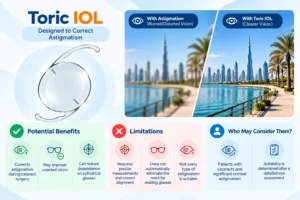
Potential benefits:
- Corrects suitable corneal astigmatism during cataract surgery.
- Can improve unaided vision when the lens is appropriately selected and aligned.
- May reduce dependence on cylindrical glasses.
Limitations:
- Requires precise measurements and correct lens alignment.
- Does not automatically eliminate the need for reading glasses.
- Not every type of astigmatism is suitable for correction with a toric IOL.
Who may consider them?
Patients with cataracts and clinically significant, regular corneal astigmatism may benefit from an assessment for a toric lens. The surgeon will use corneal measurements and other eye tests to determine whether it is appropriate.
Cataract Lens Comparison: Which Option Offers What?
The following table provides a general comparison of the main lens types.
| Lens type | Primary visual range | Potential benefit | Important consideration |
| Monofocal | One selected distance | Clear vision at the chosen focus | Glasses are commonly needed for other distances |
| Multifocal | Near and distance, depending on design | Reduced dependence on glasses | Halos and glare may occur |
| Trifocal | Near, intermediate and distance | Broader range for everyday tasks | Visual disturbances and adaptation should be considered |
| EDOF | Extended focus, particularly distance to intermediate | Useful range for screens and daily activities | Reading glasses may still be needed |
| Toric | Depends on the underlying lens design | Corrects suitable corneal astigmatism | Requires accurate measurements and alignment |
It is important to understand that toric lenses are not simply an alternative to multifocal or EDOF lenses. Toric refers to astigmatism correction, while the other categories describe how a lens focuses light. Some lenses combine these features.
Which Cataract Lens Is Right for You?
There is no single cataract lens that is best for every patient. Your preferred daily activities, eye health and expectations after surgery all influence the decision.
If you mainly want clear distance vision
A monofocal lens set for distance may be suitable if you are comfortable using glasses for reading or other close-up tasks. It is a well-established option for patients who prioritise distance vision.
If you want to reduce your dependence on glasses
Multifocal or trifocal lenses may be worth discussing if you want to perform more near and distance activities without glasses. However, the potential for halos, glare and other visual disturbances should be considered.
If you spend a lot of time on computers
An EDOF lens may be an option if intermediate vision is particularly important for your work or daily routine. Your near-vision requirements should also be considered because reading small text may still require glasses.
If you have astigmatism
A toric IOL may be appropriate if you have suitable corneal astigmatism. Detailed measurements help determine the amount of correction required and whether a toric lens is likely to improve your visual outcome.
If you have other eye conditions
Conditions affecting the cornea, retina or optic nerve, including certain cases of glaucoma or macular disease, can influence lens selection. Some multifocal or EDOF lenses may be less suitable when visual quality is already affected by another eye condition.
Your ophthalmologist will assess the health of your eyes before recommending an implant.
What Factors Should You Consider Before Choosing a Cataract Lens?
Beyond the type of lens, several factors help determine which IOL may be suitable.
- Your daily routine: Consider how much time you spend reading, using a computer, driving or performing tasks that require clear vision at different distances.
- Your eye measurements: The length of your eye, corneal curvature and other measurements help the surgeon calculate the appropriate lens power.
- Your overall eye health: Retinal disease, glaucoma, corneal problems and previous eye surgery may affect which lens designs are suitable.
- Your expectations about glasses: Some lenses can reduce dependence on glasses, but no lens can guarantee that you will never need them again.
- Night driving and visual comfort: If you frequently drive at night, discuss the possibility of halos, glare and reduced contrast with your surgeon.
- Cost and insurance coverage: Lens options may have different costs and coverage arrangements. Ask your provider which options are available, what your insurance covers and whether additional charges apply.
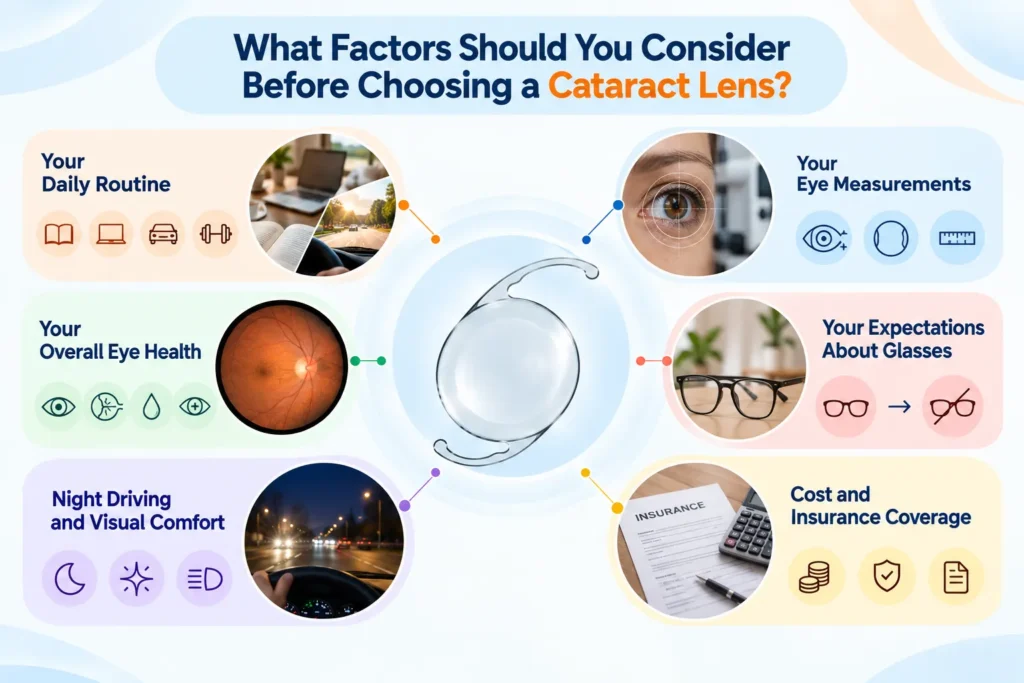
A detailed consultation helps balance these factors rather than choosing a lens based on price or popularity alone.
Are Premium Cataract Lens Implants Worth It?
Premium IOLs may offer advantages for patients who want a broader range of vision or correction of astigmatism. Depending on the lens, they may reduce the need for glasses during selected activities.
However, a higher-priced lens is not necessarily the best choice for every patient. Premium lenses may involve trade-offs, including halos, glare or the continued need for glasses. Their suitability also depends on eye health and the accuracy of preoperative measurements.
The most appropriate lens is the one that matches your clinical needs and visual priorities. Your surgeon can explain the expected benefits, limitations and costs of the available options.
Do You Still Need Glasses After Cataract Surgery?
You may still need glasses after cataract surgery, depending on the IOL selected and your individual visual outcome.
Patients with monofocal lenses set for distance generally need reading glasses for close-up tasks. Multifocal and trifocal lenses may reduce dependence on glasses across several distances, while EDOF lenses may provide a broader range of focus with some continued need for near correction.
Even after careful planning, a small residual prescription may remain. Your surgeon can assess your vision after healing and advise whether glasses or any further correction would be helpful.
Choose Your Cataract Lens With Expert Guidance in Dubai
Choosing a cataract lens implant involves more than deciding whether you want to wear glasses. It requires an understanding of the different lens designs, your eye health and the visual demands of your everyday life.
At Vasan Eye & Multispeciality Day Surgical Centre, Dubai, patients can explore available IOL options and receive personalised guidance based on their eye examination, measurements and visual goals.
If you are considering cataract surgery, schedule an assessment to discuss the lens options available to you and understand the potential benefits and limitations of each.
Explore cataract surgery in Dubai at Vasan Eye to learn more about the procedure and available lens implants.
Medical disclaimer: This article is intended for general educational purposes and does not replace a consultation with an ophthalmologist. Lens selection and surgical suitability must be determined individually following an appropriate eye examination.