
LASIK vs ICL vs PRK: Which Vision Correction Procedure Is Right for You?
If you have ever stepped out of an air-conditioned Dubai mall into August heat and watched your glasses fog over, you already know why people look into LASIK eye surgery. Then the research into LASIK in Dubai begins, and one question stalls almost everyone: LASIK, PRK or ICL?
All three can reduce your dependence on glasses and contact lenses. They get there in very different ways. The right one depends less on what you prefer and more on what your eyes can safely accommodate: corneal thickness, prescription strength, tear film, age and lifestyle.
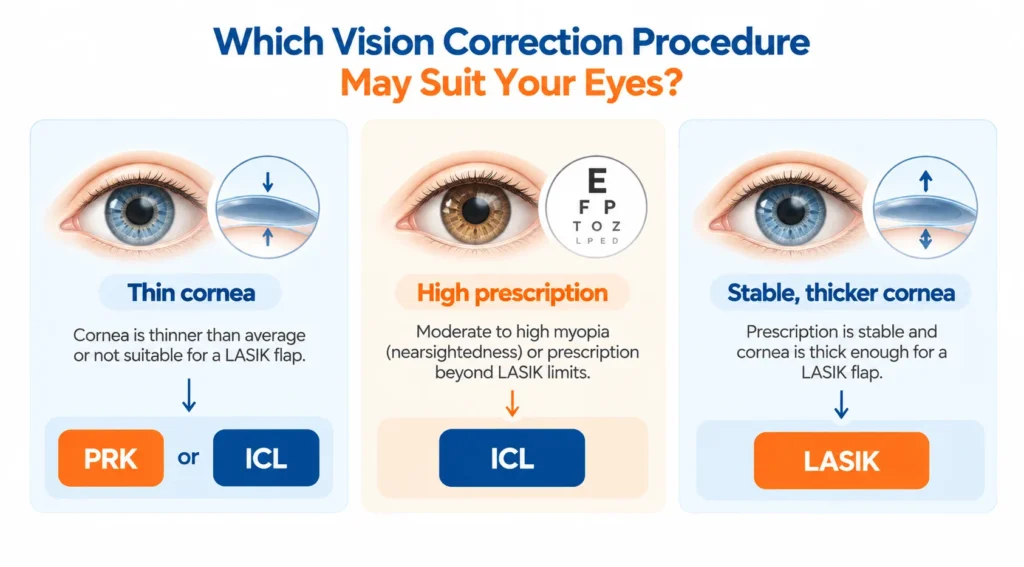
The short answer: LASIK suits many adults with a stable, low-to-moderate prescription and healthy, adequately thick corneas. PRK is often considered when the cornea is thinner or when avoiding a corneal flap makes sense. An implantable collamer lens (ICL) is often considered for higher prescriptions, or when reshaping the cornea is not the right route. Only a full eye assessment can tell you which applies to you.
LASIK vs PRK vs ICL at a glance
| LASIK | PRK | ICL | |
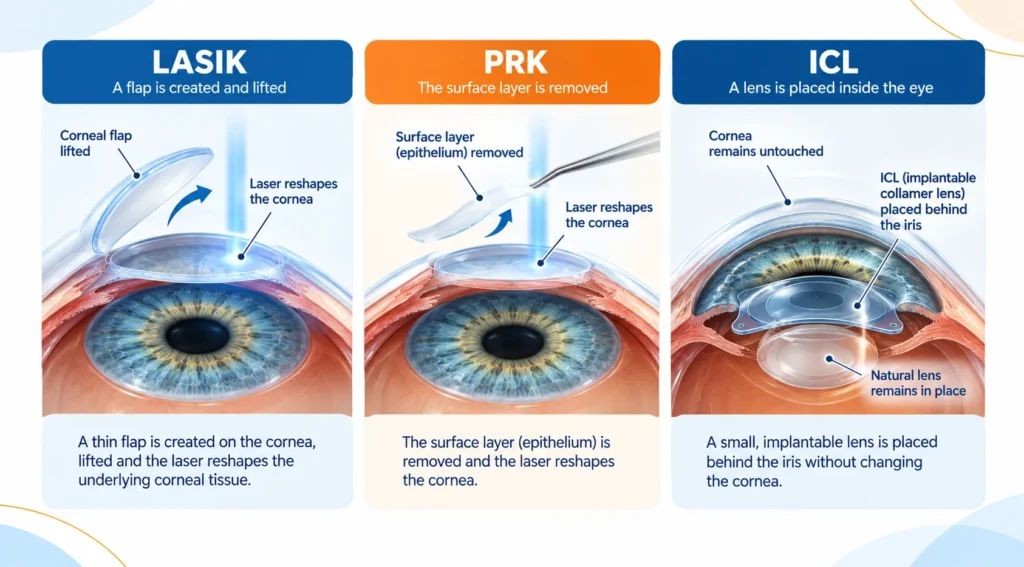
| How it works | Creates a thin corneal flap, then reshapes the cornea with an excimer laser | Removes the surface layer (epithelium), then reshapes the cornea with an excimer laser | Places a thin lens inside the eye, between the iris and the natural lens |
| Changes the cornea? | Yes | Yes | No |
| Often considered for | Stable low-to-moderate prescriptions with healthy, adequately thick corneas | Thinner corneas, dry-eye tendency, or an active or contact-sport lifestyle | Higher prescriptions, or corneas not suited to laser reshaping |
| Typical recovery | Many people notice clearer vision within 24 to 48 hours | Surface healing takes about 3 to 5 days; vision improves gradually over weeks | Your surgeon sets the timeline; follow-up monitoring continues afterwards |
| Reversible? | No | No | The lens can be removed or exchanged by a surgeon |
| Usual age window | Adults 18+ with a stable prescription | Adults 18+ with a stable prescription | Commonly 21 to 45 |
Want the detail behind each column? Vasan Eye’s pages cover LASIK surgery in Dubai, PRK eye surgery and ICL surgery in full. The rest of this guide explains how to tell which one fits your eyes.
How each procedure works
LASIK and PRK reshape the cornea, your eye’s clear front surface. ICL leaves it untouched and adds a corrective lens inside the eye.
LASIK: reshaping beneath a thin flap
LASIK is the most widely recognised laser eye surgery. After numbing drops, the surgeon creates a thin hinged flap in the cornea, an excimer laser reshapes the tissue beneath, and the flap is repositioned to heal without stitches. Treatment takes minutes per eye, and many people notice clearer vision within a day or two.
Types of LASIK surgery: surgeons choose how the flap is made (a femtosecond laser, often called bladeless LASIK, or a microkeratome blade) and how the treatment is planned (standard, wavefront-guided or topography-guided). The right mix depends on your eye measurements, not on one option being “better”.
PRK: the flapless option
PRK uses the same laser but no flap. The thin surface layer is removed, the cornea is reshaped, and a bandage lens protects the eye while it regrows. It is often considered for thinner corneas, a dry-eye tendency or contact-sport lifestyles. Recovery is slower: surface healing takes about three to five days, and vision sharpens over several weeks.
ICL: adding a lens instead of removing tissue
ICL (implantable collamer lens) is a thin lens placed through a tiny incision behind the iris, with no corneal tissue removed. It is often considered for higher prescriptions or corneas unsuited to lasers, and a surgeon can remove or exchange it. As an intraocular procedure it carries its own rare risks, such as raised eye pressure or cataract, and needs long-term monitoring. It is usually considered for ages 21 to 45.
See all three in the clinic’s refractive surgery services in Dubai.
Which procedure suits which eye?
Your glasses prescription is only the starting point. Your surgeon decides after measuring the cornea, the tear film and the rest of the eye. These are the situations that most often steer the conversation:
| Your situation | What is often considered | Why |
| Stable low-to-moderate prescription, healthy and adequately thick corneas | LASIK | Fast visual recovery for suitable candidates |
| Thinner corneas | PRK or ICL | PRK avoids a flap; ICL removes no corneal tissue |
| Dry eye | PRK or ICL, after assessment | LASIK can temporarily worsen dry eye, so the dry eye evaluation matters |
| High prescription | ICL | Laser correction has safe limits on how much tissue can be removed |
| Contact sports or physically demanding work | PRK or ICL | No corneal flap to dislodge |
| Astigmatism | LASIK, PRK or ICL | All three can correct suitable astigmatism |
| Age 40 and above | Discussed individually | No procedure stops presbyopia, the natural loss of near focus |
| Irregular or thinning cornea | Assessment first | May point to keratoconus care rather than refractive surgery |
Can you do LASIK with astigmatism?
Often, yes. Astigmatism does not automatically rule out LASIK, and many people with myopia and astigmatism are treated with it. What matters is the degree of astigmatism, the shape of your cornea and your overall eye health. Your assessment will show whether LASIK, PRK or ICL is the better route for your measurements.
Dubai lifestyle questions worth asking
A good consultation covers your daily reality, not just your numbers. Long hours in air-conditioned offices, heavy screen use, desert dust and strong sun all affect how your eyes feel while healing. Tell your surgeon about them, along with how often you drive at night, play sport or travel.
If you are over 45 and noticing early lens changes, the clinic’s cataract surgery and lens implant options are a different pathway worth knowing about.
Is LASIK safe? Understanding the risks of each procedure
People search “is LASIK safe”, “is LASIK surgery safe” and “is LASIK eye surgery safe” for good reason. LASIK is an established procedure performed worldwide, and it is generally considered safe for carefully selected candidates treated by qualified ophthalmologists. But every surgery carries risk, and no outcome can be guaranteed. Safety depends heavily on whether the procedure suits your eyes in the first place.
The main risks to discuss with your surgeon:
- LASIK: dry eye, glare or halos around lights, under- or over-correction that may need an enhancement, and, rarely, flap complications or infection.
- PRK: more discomfort and light sensitivity in the first days, slower visual recovery, temporary haze in some patients, and, rarely, infection.
- ICL: raised eye pressure, cataract formation, loss of corneal cells or lens-position problems in rare cases, which is why regular follow-up matters.
Worried you might not qualify? Our guide to whether you are a good candidate for LASIK lists seven questions to bring to your appointment.
What does laser eye surgery cost in Dubai?
There is no single price for laser eye surgery in Dubai, because the procedure itself is only part of the picture. Costs vary with:
- The procedure: LASIK, PRK or ICL, which use different technology and, in ICL’s case, a custom lens.
- The complexity of your prescription and any astigmatism.
- The diagnostic tests and the technology used for planning and treatment.
- Follow-up visits, medications and the clinic’s policy on enhancements.
When you compare quotes, compare what is included, not just the headline fee. These procedures are usually elective, so insurance coverage varies; the clinic’s insurance and payments page is the place to check. For a deeper look at costs and recovery, read our LASIK eye surgery in Dubai guide.
What happens at a vision correction assessment?
This visit decides everything, so it is worth knowing what it involves. A thorough assessment typically includes:
- Refraction history and testing to confirm your prescription has been stable, usually for about a year.
- Corneal topography or tomography to map the shape of your cornea.
- Pachymetry to measure corneal thickness.
- Wavefront analysis to see how light travels through your whole eye.
- Dry eye and ocular surface assessment to check tear quality.
- A full eye health examination to rule out conditions that affect suitability.
Your clinic will tell you how long before the visit to stop wearing contact lenses, because lenses can temporarily change corneal shape. If you have not had a recent check-up, what to expect during an eye test visit explains the basics.
Vision correction at Vasan Eye, Al Karama
Vasan Eye & Multispeciality DSC is a Quad A accredited day surgical centre at Zabeel Plaza, Zabeel Road, Al Karama, Dubai. Its refractive surgery service covers LASIK, PRK and ICL, so the recommendation can follow your eyes rather than a single procedure.
Planning uses corneal topography, wavefront-guided analysis and a dry eye assessment, and laser treatment is delivered with a WaveLight EX500 excimer laser. Every candidate is assessed for prescription stability, corneal thickness, overall eye health, lifestyle and long-term goals before a procedure is suggested.
Your refractive surgery team includes Dr. Umesh Patinjarekandy (MBBS, MS Ophthalmology), a Phaco and Refractive Surgeon, and Dr. Tahere Rezaei (MBBS, MD Ophthalmology), a Cataract and Refractive Surgeon. International visitors can also read about medical travel to Dubai for eye care.
The right procedure is the one your eyes can support
LASIK, PRK and ICL are three routes to the same goal, and the best fit is decided by your cornea, your prescription, your tear film and your lifestyle, not by which name is most familiar. The most useful first step is a thorough assessment with an ophthalmologist who can explain your options and your risks in plain language.
If you are considering LASIK eye surgery in Dubai, or want to know whether PRK or ICL suits you better, book a vision correction assessment at Vasan Eye or message the team on WhatsApp. You can also call +971 55 396 3542.
This article is for general information and does not replace professional medical advice. Suitability, risks and results vary between individuals and can only be assessed through an in-person examination.
References
- LASIK: Laser Eye Surgery, American Academy of Ophthalmology (candidacy, risks, vision outcomes and presbyopia)
- Vasan Eye service pages: Refractive Surgery, LASIK Surgery in Dubai, PRK Eye Surgery in Dubai