

Eye Floaters Treatment in Dubai
Eye floaters are small spots, threads or cobweb-like shapes that drift across your vision. Most are harmless and become less noticeable over time, but a sudden increase in floaters can indicate a retinal tear or detachment that needs urgent attention.
At Vasan Eye & Multispeciality DSC in Al Karama, Dubai, our ophthalmologists and retina specialists assess the cause of eye floaters and recommend appropriate care. Depending on the findings, eye floater treatment in Dubai may involve observation, management of an underlying eye condition or, in selected cases, vitrectomy surgery.
Do Eye Floaters Need Treatment?
Most eye floaters do not require treatment. They often develop as the vitreous, the gel-like substance inside the eye, changes with age. Over time, the brain may adapt to these shapes, making them less noticeable.
However, new or worsening floaters should not be ignored. A sudden shower of floaters, flashes of light or a dark shadow across your vision may indicate a retinal problem.
Treatment depends on the cause and how much the floaters affect your vision. Options include:
- Observation: For floaters that are harmless and do not significantly affect daily activities.
- Treatment of the underlying condition: When floaters are associated with retinal bleeding, inflammation or another eye disorder.
- Vitrectomy surgery: For selected patients whose floaters significantly interfere with vision and daily life.
No eye drops, supplements or eye exercises have been proven to remove floaters.
What Are Eye Floaters?
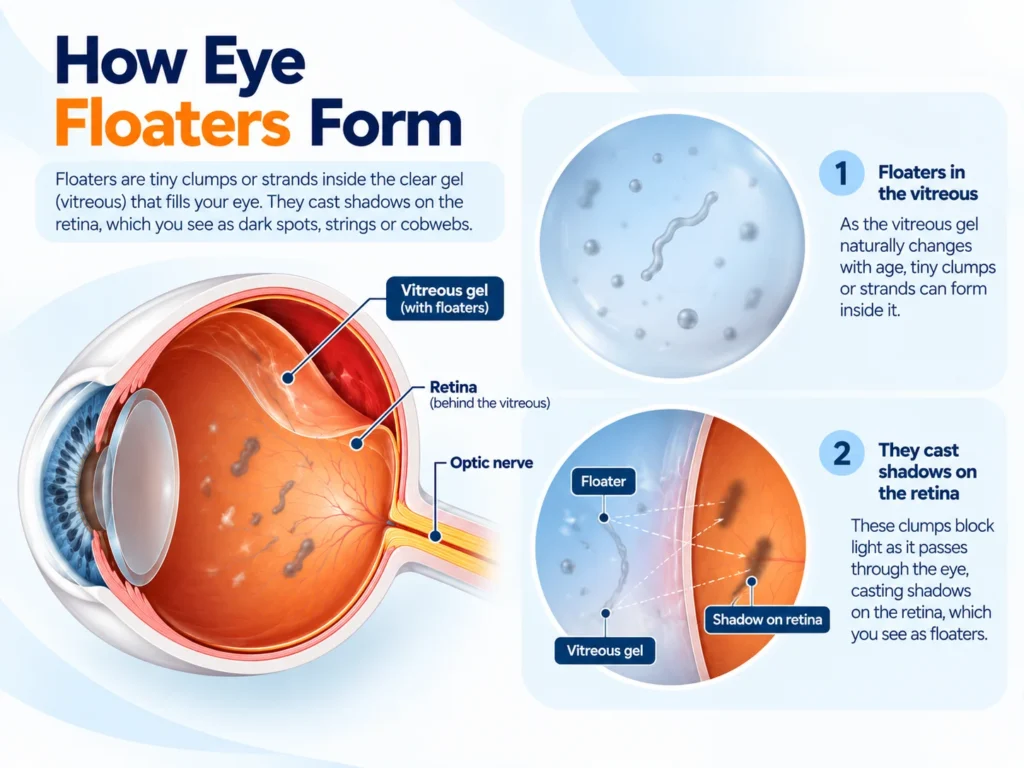
Eye floaters are small shapes that appear to move across your field of vision. They may look like dark dots, fine threads, cobwebs, rings or cloudy patches. They are often easier to see against a bright background, such as a clear sky, a white wall or a computer screen.
Inside the eye is a clear, jelly-like substance called the vitreous. As you age, this substance gradually changes in consistency, and tiny collagen fibres may clump together. These clumps cast shadows on the retina, the light-sensitive tissue at the back of the eye. You see these shadows as floaters.
Floaters may move when you move your eyes and continue drifting after your eyes stop. Although many are related to normal ageing, some can develop because of vitreous detachment, inflammation, bleeding or retinal disease.
Reach Out for Expert Care
What Are the Symptoms of Eye Floaters?
Eye floaters can appear in different shapes and sizes. Common symptoms include:
- Small spots, dots or specks drifting across your vision
- Fine lines, threads or cobweb-like shapes
- Floaters that move when you move your eyes
- Shapes that are more noticeable against bright or plain backgrounds
- A ring-shaped floater that may appear when the vitreous separates from the retina
Occasional floaters are common. However, a sudden change in their number, appearance or intensity should be assessed by an eye specialist, particularly if accompanied by flashes or reduced vision.
When Do Eye Floaters Require Urgent Medical Attention?
Most floaters are harmless, but some are associated with conditions that can threaten sight. A retinal tear can allow fluid to pass beneath the retina, potentially causing retinal detachment.
Seek immediate eye assessment if you experience:
- A sudden shower of new floaters
- New flashes of light, particularly in one eye
- A dark curtain, shadow or veil across part of your vision
- Sudden blurred vision or loss of part of your visual field
- New floaters following an eye injury or recent eye surgery
These symptoms may indicate a retinal tear, retinal detachment or bleeding inside the eye. Prompt assessment and treatment can help reduce the risk of permanent vision loss.
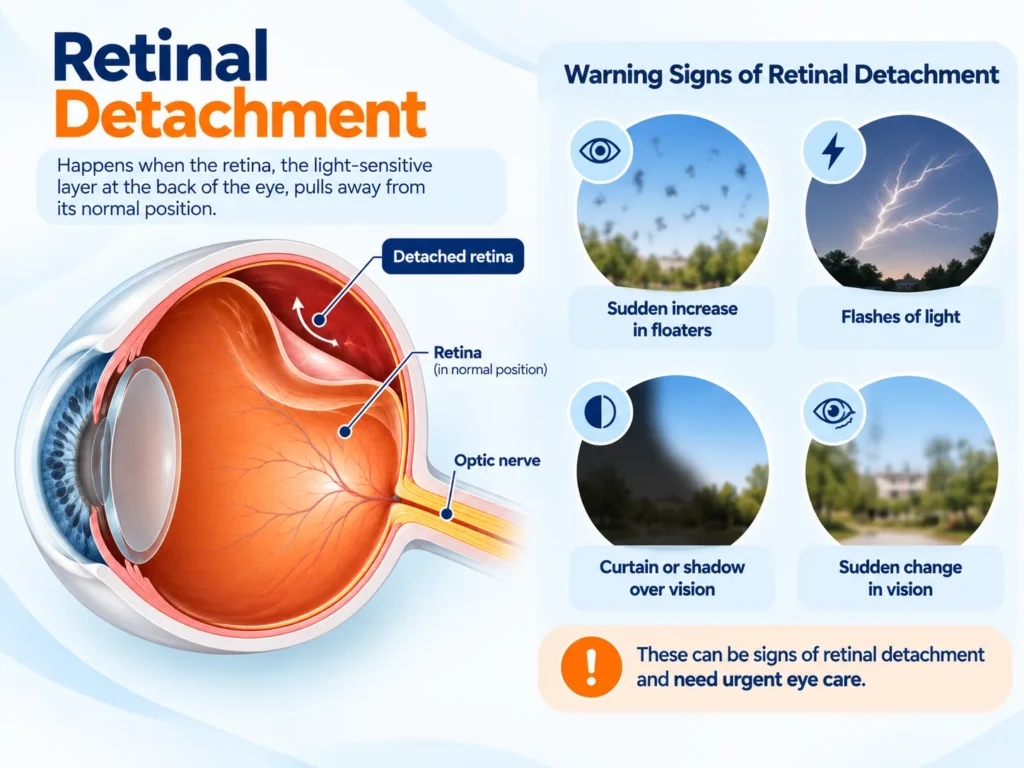
If you experience these warning signs, do not wait for a routine appointment. Contact an eye specialist urgently or visit the nearest hospital emergency department if immediate eye care is unavailable.
What Causes Eye Floaters?
Eye floaters can develop for several reasons. Identifying the cause helps determine whether monitoring or treatment is needed.
1. Age-Related Vitreous Changes
As people get older, the vitreous becomes more liquid, and its fibres may clump together. These changes are among the most common causes of floaters.
2. Posterior Vitreous Detachment (PVD)
Posterior vitreous detachment occurs when the vitreous separates from the retina. It may cause a sudden increase in floaters and flashes of light. Although many cases do not lead to serious complications, the separation can sometimes cause a retinal tear. A dilated retinal examination is therefore important when symptoms begin.
3. Short-Sightedness (Myopia)
People with significant short-sightedness may develop floaters earlier and have an increased risk of certain retinal complications. New floaters should be assessed rather than assumed to be related to their prescription.
4. Diabetes and Diabetic Retinopathy
Diabetic retinopathy can damage retinal blood vessels. In some cases, abnormal blood vessels bleed into the vitreous, causing new dark floaters or sudden vision changes.
People with diabetes should maintain regular retinal screening and seek prompt assessment if new floaters develop. Learn more about diabetic retinopathy treatment in Dubai.
5. Eye Inflammation (Uveitis)
Inflammation inside the eye can release cells into the vitreous, causing floaters. Treatment depends on the underlying inflammatory condition.
6. Eye Injury or Surgery
Floaters may appear after an eye injury or certain eye procedures. New symptoms following surgery or trauma should be assessed promptly.
7. Other Retinal Conditions
Retinal vein occlusion, bleeding within the eye and other retinal disorders can also cause floaters. Less common causes may require additional investigation.
How Are Eye Floaters Diagnosed?
A dilated retinal examination is the key step in evaluating new eye floaters. It allows your ophthalmologist to examine the retina for tears, detachment and other possible causes.
Your assessment may include a review of your symptoms and medical history, visual acuity testing and a dilated retinal examination. Depending on the findings, your ophthalmologist may recommend additional investigations, such as optical coherence tomography (OCT), fundus imaging, fluorescein angiography or eye pressure measurement. Not every patient requires all these tests.
Dilating drops take time to work. Your vision may remain blurry and light-sensitive for several hours afterwards, so arrange for someone to drive you if needed.
Reach Out for Expert Care
Eye Floaters Treatment Options in Dubai
The right eye floaters treatment depends on whether the floaters are harmless, whether an underlying condition is present and how much they affect daily activities.
| Option | Best for | What it involves |
| Observation | Most people, once a retinal tear or detachment is ruled out | Regular monitoring; floaters often fade or become easier to ignore |
| Vitrectomy | Severe floaters that disrupt daily life in an otherwise healthy eye | Day-surgery removal of the vitreous and its floaters |
| Treating the underlying cause | Floaters caused by a retinal tear, bleeding, inflammation or diabetic eye disease | Care directed at the cause |
1. Observation and Monitoring
For most patients, this is the right choice. Once serious conditions are excluded, floaters often become less noticeable over weeks to months as the brain learns to ignore them.
We advise a follow-up check if your symptoms change, and sometimes a repeat examination after a new PVD, because a retinal tear can develop later.
2. Vitrectomy Surgery for Severe Eye Floaters
Vitrectomy can remove persistent, troublesome floaters, but it is an invasive procedure with potentially serious complications. It may be considered for carefully selected patients whose floaters significantly interfere with daily activities after a specialist assessment. The potential benefits must be weighed against the risks, and observation may remain the preferred option for many patients.
What it involves: When vitrectomy is considered appropriate, your vitreoretinal surgeon will explain the procedure, anaesthesia options, expected recovery and follow-up requirements. Whether it is performed as a day case and which anaesthesia is used depends on the procedure and your individual circumstances.
Possible risks: Possible complications include cataract development or progression in eyes with a natural lens, retinal tears or detachment, bleeding, raised eye pressure and infection. The likelihood of each complication depends on the patient’s circumstances and the procedure performed. Your vitreoretinal surgeon should explain the relevant risks, expected benefits and alternatives before surgery.
Recovery: most people resume light activity within days, with eye drops for several weeks and follow-up visits. Your surgeon will give specific advice on exercise, flying and heavy lifting.

3. Treating the Underlying Cause
If floaters are caused by a retinal tear, bleeding or inflammation, the priority is treating that problem. Treatment depends on the underlying diagnosis. A retinal tear may require prompt laser treatment or another procedure; inflammation may require condition-specific therapy; and diabetic retinal disease may need treatment such as injections, laser therapy or surgery, depending on its severity. Your ophthalmologist will recommend treatment based on the examination findings.
Can Home Remedies Remove Eye Floaters?
No home remedy, eye drop, vitamin supplement or eye exercise has been proven to remove eye floaters. Many floaters become less noticeable over time as the brain adapts to them.
If floaters interfere with your daily activities, consult an eye specialist. Do not delay an eye examination while trying home remedies, especially if floaters appear suddenly or are accompanied by flashes of light or changes in vision.
Eye Floaters Care at Vasan Eye, Dubai
Choosing an appropriate eye specialist is important when floaters are new, persistent or affecting your vision. At Vasan Eye & Multispeciality DSC in Al Karama, patients can access ophthalmic assessment and specialised retinal care.
- Retina expertise: Dr. Lakshmi K. Vijayaraghavan, Medical Retina Specialist, and Dr. Nikhil Pal, Retina & Uvea Specialist
- Advanced diagnostics on site: OCT and fundus imaging with fluorescein angiography
- Honest guidance: we tell you when treatment is not needed
- Convenient location: Zabeel Plaza, Zabeel Road, Al Karama, Dubai, with parking, a multilingual team and 30+ insurance partners
Book an Eye Assessment in Dubai
New or worsening floaters deserve attention, particularly when accompanied by flashes of light or changes in vision. An eye examination can help identify the cause and determine whether monitoring or treatment is needed.
At Vasan Eye & Multispeciality DSC, Al Karama, Dubai, an ophthalmology assessment can help you understand your symptoms and the next steps in your care.
Book an Appointment | WhatsApp us | Call +971 55 396 3542
Vasan Eye & Multispeciality DSC, Zabeel Plaza, Zabeel Road, Al Karama, Dubai, UAE | 800 VASAN (82726) | info@vasaneye.ae
Medical Disclaimer
This page is for general information and does not replace personal medical advice. Only an eye specialist can diagnose the cause of floaters and recommend suitable treatment. If you experience sudden floaters, flashes or loss of vision, seek urgent medical care.
References
- National Eye Institute (NEI) — Floaters
- American Academy of Ophthalmology (AAO) — What Are Floaters and Flashes?
- National Eye Institute (NEI) — Vitreous Detachment
- National Eye Institute (NEI) — Vitrectomy
- NHS — Floaters and Flashes in the Eyes
- Mayo Clinic — Eye Floaters: Diagnosis and Treatment

Vasan Eye & Multispeciality DSC's Medical Content Team
Vasan Eye & Multispeciality DSC’s medical content team specialises in creating accurate, clear, and patient-focused healthcare content. With strong clinical understanding and expertise in technical writing and SEO, the team translates complex medical information into reliable, accessible resources that support informed decisions and uphold Vasan Eye & Multispeciality DSC’s commitment to quality care.