

Trabeculectomy Surgery in Dubai
When glaucoma continues to damage the optic nerve despite treatment, simply adding another eye drop is not always the answer. In some eyes, the pressure needs to be lowered further to reduce the risk of additional, irreversible vision loss. This is when your ophthalmologist may discuss glaucoma surgery. Trabeculectomy is a glaucoma filtration procedure that creates an alternative route for fluid to drain from the eye, helping lower intraocular pressure. It is generally considered when medicines or laser treatment have not achieved adequate pressure control, or when the level of glaucoma damage means a lower target pressure is needed. The important question, however, is not simply whether trabeculectomy surgery in Dubai can lower eye pressure. It is whether it is the right procedure for your eye, at this stage of your glaucoma.
At Vasan Eye & Multispeciality Day Surgical Center, Al Karama, Dubai, glaucoma assessment includes eye-pressure measurement, optic nerve evaluation, OCT, visual field analysis, gonioscopy and other investigations when clinically required. The results help the ophthalmologist understand how the disease is behaving and determine whether continued medical treatment, laser therapy or glaucoma surgery should be considered. If you have been advised to consider trabeculectomy, the first step is a detailed glaucoma assessment and then decide for the surgery.
What Is Trabeculectomy?
A type of Glaucoma Surgery
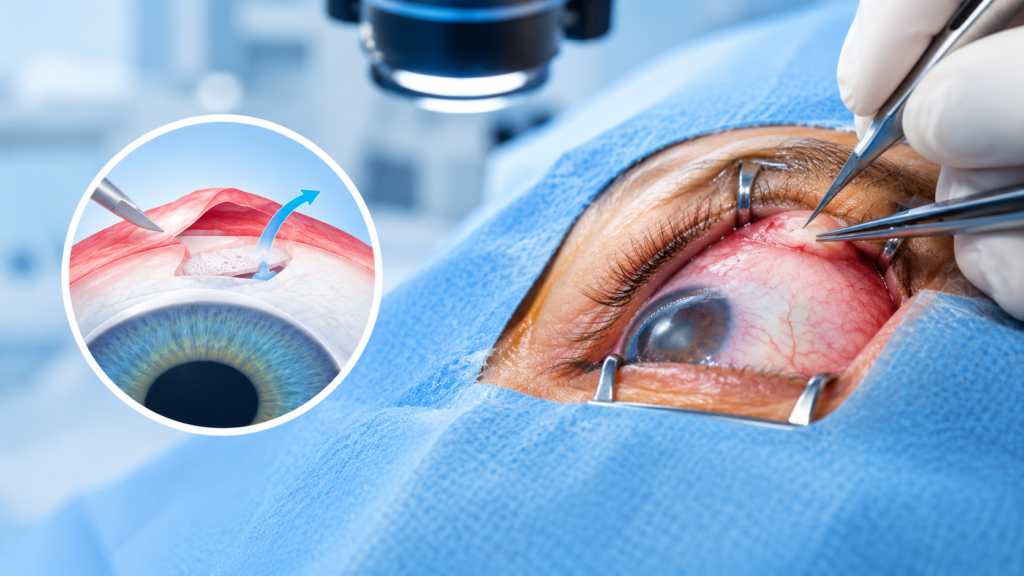
Trabeculectomy is a glaucoma surgery that creates a new drainage pathway for aqueous humour, the natural fluid produced inside the eye.
Normally, a clear fluid called aqueous humour is continuously produced inside the eye and drains out through tiny drainage channels. If these channels do not work properly, fluid can build up and increase eye pressure. Over time, high eye pressure can damage the optic nerve and lead to permanent vision loss. During trabeculectomy surgery, the surgeon creates a new drainage pathway for this fluid. Instead of leaving the eye through the usual drainage channels, some of the fluid moves into a small space under the thin outer covering of the eye, called the conjunctiva. This creates a small raised area called a filtering bleb, where the fluid collects and is gradually absorbed.
The aim of trabeculectomy is to lower eye pressure to a safer level and help protect the remaining vision from further glaucoma damage. Trabeculectomy does not repair an already damaged optic nerve and does not restore vision that has been permanently lost to glaucoma.
Why Might I Need Trabeculectomy and How Doctor Decides??
Glaucoma treatment usually starts with approaches that are less invasive, such as prescription eye drops or laser treatment. Many patients can control their eye pressure successfully with these treatments. Surgery may enter the discussion when the current treatment is no longer providing enough control.
Your ophthalmologist may consider trabeculectomy when:
- Eye pressure remains above the desired target despite medication
- Glaucoma is continuing to progress despite treatment
- The optic nerve shows significant or progressive damage
- A very low target eye pressure is required to protect the remaining vision
- Eye drops are not tolerated or cannot be used effectively
- Previous laser treatment has not provided sufficient pressure reduction
- The overall risk of further vision loss is considered significant
The decision is based on more than one pressure reading. For example, an eye with early glaucoma may tolerate a different pressure from an eye with advanced optic nerve damage. Your target pressure is therefore individual to your eye and your stage of disease.
How Does a Doctor Decide If Trabeculectomy Is Right for Me?
There is no single test that automatically means you need trabeculectomy.
Your ophthalmologist looks at the whole picture including your eye pressure, optic nerve, visual field, OCT findings, type of glaucoma, previous treatment and how quickly the disease is changing.
- Eye pressure: Checks whether your current treatment is controlling eye pressure.
- Optic nerve: Looks for glaucoma damage and signs of progression.
- OCT scan: Measures the optic nerve and retinal nerve fibre layer.
- Visual field test: Checks for changes in your peripheral or central vision.
- Type of glaucoma: Determines whether you have open-angle, angle-closure or another type.
- Previous treatment: Reviews your response to eye drops, laser treatment or previous surgery.
- Overall eye health: Considers previous eye surgery, inflammation, scarring and other eye conditions.
What Happens During Trabeculectomy Surgery?
Understanding what happens during the procedure can make the prospect of glaucoma surgery less daunting.
Before surgery
Your ophthalmologist will review your examination and test results and confirm the surgical plan. You will receive instructions about your regular medicines, eye drops, eating and drinking, and what you should bring or arrange for the day of surgery. The type of anaesthesia used will depend on your individual circumstances and the surgeon's recommendation.
During surgery
- A small opening is made in the sclera, the white part of the eye.
- A new drainage pathway is created to help aqueous fluid leave the eye.
- The fluid collects beneath the conjunctiva and is gradually absorbed.
- This creates a small filtering bleb that helps lower eye pressure.
- An anti-scarring medicine may be used in some patients to help prevent the new drainage pathway from closing.
- The surgical technique is tailored to the patient's glaucoma, previous treatment and overall eye health.
After surgery
Your eye will be examined before you leave the centre, and you will receive postoperative instructions and prescribed eye drops. The operation itself is only one part of the treatment.
How the eye heals afterwards is equally important.
You will therefore need scheduled follow-up appointments so your ophthalmologist can monitor eye pressure, inflammation, wound healing and the filtering bleb.
What Is a Trabeculectomy Bleb?
If you have been researching trabeculectomy, you may have come across the term “bleb.” A filtering bleb is the small area beneath the conjunctiva where aqueous fluid collects after passing through the new drainage pathway. It may appear as a small, raised area on the white part of the eye. This is an expected part of the procedure rather than a separate growth or tumour.
Your ophthalmologist will examine the bleb during follow-up to assess whether it is functioning as intended and whether the eye is healing normally. Because scar tissue can affect the drainage pathway, regular postoperative review is an important part of trabeculectomy care.
What Tests Are Done Before Glaucoma Surgery?
A detailed glaucoma evaluation helps determine whether surgery is necessary and provides a baseline against which future changes can be measured. Depending on your condition, your assessment may include:
- Tonometry: Measures intraocular pressure.
- Optic nerve examination: Looks for glaucoma-related structural damage.
- OCT scan: Provides detailed imaging of the optic nerve and retinal nerve fibre layer.
- Visual field test: Assesses functional changes in your field of vision.
- Gonioscopy: Examines the drainage angle and helps determine the type of glaucoma.
- Pachymetry: Measures corneal thickness, which can be relevant when interpreting eye-pressure measurements.
- Additional eye examination: Your ophthalmologist may also examine the cornea, lens, retina and other structures before surgery.
Trabeculectomy vs Laser Treatment for Glaucoma vs Glaucoma Tube Shunt Surgery
Glaucoma Treatment Appraoches
| Trabeculectomy | Laser Treatment (SLT) | Glaucoma Tube Shunt |
| Creates a new drainage pathway for aqueous fluid. | Helps improve drainage through the eye's existing drainage system. | Uses an implanted tube and drainage device to redirect fluid. |
| Surgical procedure. | Laser-based, minimally invasive procedure. | Surgical procedure involving an implanted device. |
| Creates a filtering bleb under the conjunctiva. | Does not create a filtering bleb. | Fluid drains through the tube to a reservoir beneath the conjunctiva. |
| May be considered when medicines or laser treatment do not provide enough pressure control. | May be suitable for selected patients depending on the type and stage of glaucoma. | May be considered in certain complex cases or after previous eye surgery. |
| Can provide substantial pressure reduction when a low target eye pressure is needed. | Pressure reduction varies between patients. | Can provide significant pressure reduction in appropriately selected patients. |
| Requires close monitoring while the eye heals. | Generally has a simpler recovery than glaucoma surgery. | Requires postoperative monitoring and follow-up. |
| Uses the eye's own tissues to create the drainage pathway. | Works on the eye's existing drainage pathway. | Requires an implanted drainage device. |
| May be considered for advanced or progressing glaucoma in selected patients. | Often considered before more invasive glaucoma surgery when appropriate. | Often considered when trabeculectomy is unsuitable or in selected complex cases. |
Recovery & Follow Up
Minimally invasive, patient-focused surgical care
What Is Recovery Like After Trabeculectomy?
Trabeculectomy recovery is not simply about waiting for the eye to heal. The drainage pathway needs to be monitored while the eye responds to surgery. During the early recovery period, you may notice:
- Redness
- Watering
- Mild discomfort or irritation
- Light sensitivity
- Temporary or fluctuating blurred vision
- A foreign-body sensation
These symptoms can vary between patients.
Follow-up after Trabeculectomy
Your ophthalmologist may check intraocular pressure, filtering bleb, inflammation, wound healing, vision and signs of infection or other complications. Your postoperative eye drops may also be adjusted according to how your eye is healing.
In some cases, the surgeon may need to intervene or modify treatment during the healing period to help maintain the function of the drainage pathway.
What should I avoid after trabeculectomy?
Your surgeon will give you specific restrictions based on your recovery. You may need to temporarily avoid activities that could place pressure on the eye or increase the risk of contamination or injury. Do not rub the operated eye, and do not stop or change prescribed eye drops unless your ophthalmologist tells you to.
What Are the Risks of Trabeculectomy?
Trabeculectomy can be effective at lowering eye pressure, but it is still surgery and has potential risks. Possible complications include:
- Infection
- Bleeding
- Inflammation
- Eye pressure becoming too low
- Eye pressure remaining higher than intended
- Scarring of the filtering pathway
- Filtering bleb-related complications
- Changes in vision
- Cataract progression in some patients
- Corneal or other eye complications
- Need for additional treatment or further surgery
The risk is not the same for every patient. Previous eye surgery, the type and severity of glaucoma, medications, healing response and other eye conditions can influence the outcome. Your ophthalmologist should explain the potential benefits, limitations and risks before surgery so that you can make an informed decision.
Can Trabeculectomy Cure Glaucoma?
No. Trabeculectomy does not cure glaucoma. The optic nerve damage already caused by glaucoma cannot generally be reversed. The purpose of surgery is to lower eye pressure and reduce the risk of additional damage. This means a successful operation does not mean that glaucoma has disappeared. You will still need periodic glaucoma examinations after surgery so your ophthalmologist can monitor your eye pressure and optic nerve health.
Will I Still Need Glaucoma Eye Drops After Trabeculectomy?
You may, but not every patient needs the same medication after surgery. Some patients require fewer glaucoma drops after a successful trabeculectomy. Others may continue to need medication to maintain their target eye pressure. Your ophthalmologist will make this decision based on your postoperative eye pressure and the performance of the filtering pathway.
Do not stop glaucoma eye drops yourself, even if your vision feels stable.
How Much Does Trabeculectomy Cost in Dubai?
Minimally invasive, patient-focused surgical care
The cost of trabeculectomy surgery in Dubai cannot be accurately determined without assessing the patient's eye and treatment requirements.
The overall cost may depend on:
- Preoperative glaucoma investigations
- Complexity of the procedure
- Surgeon and facility charges
- Anaesthesia
- Medicines
- Postoperative reviews
- Additional treatment, if required
- Insurance coverage
At Vasan Eye & Multispeciality DSC, the treatment plan and associated costs can be discussed after your glaucoma evaluation. Vasan Eye Dubai supports major UAE insurance providers, although coverage and approval depend on the individual insurance policy and treatment.

Trabeculectomy Surgery at Vasan Eye & Multispeciality DSC, Dubai
13+ Years of Serving Eye Patients
Choosing glaucoma surgery is not only about finding a centre that performs the procedure. It is about having the right evaluation before surgery and appropriate monitoring afterwards. At Vasan Eye & Multispeciality Day Surgical Center in Al Karama, Dubai, glaucoma care covers assessment, medical management, laser treatment and surgical options. The glaucoma services include trabeculectomy, glaucoma drainage device surgery and MIGS alongside diagnostic and medical treatment. You get treated by eye doctors with years of experience and surgical expertise.
What Your Glaucoma Care May Involve at Vasan
01. Consultation: Discuss your glaucoma history, symptoms, previous treatment and concerns with the ophthalmologist.
02. Glaucoma assessment: Your eye pressure, optic nerve, visual field and relevant imaging are assessed.
03. Treatment decision: Your ophthalmologist determines whether continued medication, laser treatment or surgery is appropriate.
04. Surgical planning: If trabeculectomy is recommended, you receive instructions about preparation, medicines and the procedure.
05. Trabeculectomy: A new drainage pathway is created to help lower intraocular pressure.
06. Early follow-up: Your eye is monitored closely as the filtering pathway begins to function and the tissues heal.
07. Long-term monitoring: Regular glaucoma reviews continue to protect the vision that remains.
Frequently Asked Questions
About Trabeculectomy
What is trabeculectomy surgery for glaucoma? expand_more
Trabeculectomy is a glaucoma filtration surgery used to lower intraocular pressure by creating an alternative drainage pathway for aqueous fluid. It may be considered when eye drops or laser treatment have not provided sufficient pressure control or when a lower target pressure is needed.
When is trabeculectomy recommended for glaucoma? expand_more
Trabeculectomy may be recommended when glaucoma continues to progress despite treatment, eye pressure remains above the desired target, or significant optic nerve damage means a substantial pressure reduction is required.
Is trabeculectomy the best glaucoma surgery? expand_more
There is no single best glaucoma surgery for every patient. Trabeculectomy, glaucoma tube shunt surgery, MIGS and laser procedures have different indications. The appropriate treatment depends on glaucoma type, severity, target pressure, previous treatment and the condition of the eye.
Is trabeculectomy painful? expand_more
For Trabeculectomy, the eye is anaesthetised during the operation. Some redness, irritation, watering, light sensitivity or discomfort can occur afterwards. An ophthalmologist will prescribe postoperative treatment to support healing.
How long does it take to recover from trabeculectomy? expand_more
Trabeculectomy recovery varies between patients. Vision may fluctuate during the early healing period, and regular follow-up is required to monitor eye pressure, inflammation and the filtering bleb.
Can trabeculectomy restore vision lost from glaucoma? expand_more
No. Trabeculectomy cannot reverse established glaucoma-related optic nerve damage. Its purpose is to lower eye pressure and help reduce the risk of further vision loss.
Will I need glaucoma eye drops after trabeculectomy? expand_more
Possibly. Some patients need fewer medications after surgery, while others continue to require glaucoma eye drops to maintain their target pressure. Your ophthalmologist will decide based on your response to surgery.
What is the difference between trabeculectomy and trabeculoplasty? expand_more
Trabeculectomy creates a new drainage pathway, while trabeculoplasty uses laser treatment to improve drainage through the eye's existing drainage system. The appropriate procedure depends on the type and severity of glaucoma and previous treatment.