
Retinoblastoma Treatment in Dubai
Retinoblastoma treatment in Dubai provides access to advanced diagnostic and treatment options for retinoblastoma, the most common eye cancer affecting young children. Although rare, this condition occurs in approximately 1 in every 15,000–20,000 live births worldwide. It typically develops before the age of five and can affect one or both eyes. When detected early, retinoblastoma is highly treatable, with excellent survival rates and a greater likelihood of preserving vision.
Advances in paediatric ophthalmology and ocular oncology have significantly improved the management of retinoblastoma. Depending on the size, location, and extent of the tumour, treatment may include chemotherapy, laser therapy, cryotherapy, intravitreal injections, radiation therapy, or surgery. The primary goals of treatment are to eliminate the cancer, preserve the eye whenever possible, and maintain useful vision while preventing the disease from spreading.
At Vasan Eye & Multispeciality Day Surgical Center (DSC), our experienced paediatric eye specialists provide comprehensive evaluation, accurate diagnosis, and personalised treatment plans for children with retinoblastoma. Using advanced technology and evidence-based treatment approaches, our multidisciplinary team focuses on delivering safe, effective, and compassionate care while supporting families throughout every stage of diagnosis, treatment, and follow-up.
What is Retinoblastoma?
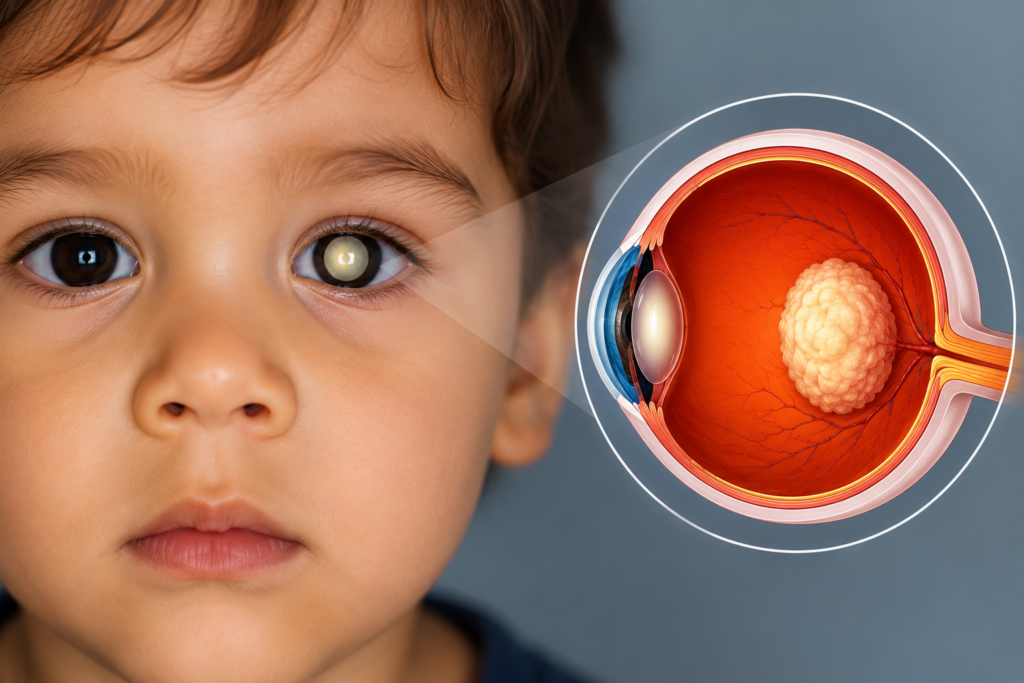
Retinoblastoma is a serious condition that arises in the retinal cells. It is the most frequent type of primary eye cancer found in children, usually detected in children before they turn five years old. This happens when the genetic makeup of the retinal cells changes abnormally, causing them to multiply uncontrollably, resulting in tumours. Early diagnosis and prompt medical management are critical for the protection of the child’s eyesight, saving the eye, and avoiding the risk of cancer metastasis.
Retinoblastoma can be either unilateral, where only one eye is affected, or bilateral when both eyes have the tumour. In most cases, it could be due to a change in the genetic makeup caused by a mutation on the RB1 gene, whereas in other cases, it is not hereditary. Children who inherit retinoblastoma are predisposed to having tumours in both their eyes. Despite the rarity of retinoblastoma, it is regarded as one of the important conditions that affects children’s eyes because of its implications. Through advancements in the area of genetics and technology, researchers have been able to understand this illness better and treat it efficiently.
Grouping Retinoblastoma Stages: Understanding Disease Progression
The staging of retinoblastoma refers to how much cancer has grown in the eyes and if it has spread to other areas. It gives medical professionals an idea of the extent of the disease and helps them determine the best course of action for treating the condition. The International Classification of Retinoblastoma (ICRB) is commonly used when grouping retinoblastomas based on their stage.
- Group A (Very Early Stage): These tumours are small in size and stay in the retina while avoiding areas like the optic nerve and macula. They are regarded as low-risk tumours since they do not spread much.
- Group B (Early Stage): Here, tumours are larger in size and stay in the retina. However, they might grow near the visual centres in the eye. No growth occurs inside the eye, but tumours occupy more space than those in Group A.
- Group C (Moderate Stage): There are only slight local invasions of tumour cells into the vitreous body or underneath the retina. Although there is some progression from the earlier stages, it is still mostly localised within the eye.
- Group D (Advanced Intraocular Stage): Large tumours, with significant spreading of tumour cells into the vitreous body or underneath the retina. It involves a considerable share of the eye and poses a serious threat to one’s vision.
- Group E (Most Advanced Intraocular Stage): The eye is heavily damaged by the tumour, which may invade its structures, such as the optic nerve and the anterior chamber. As a result, at this stage, the eye may not be able to give any vision anymore.
- Extravascular Retinoblastoma: Rarely, there might be an occurrence when retinoblastoma extends outside of the eye and metastasises to tissues adjacent to the eyes or even affects bones or the brain. In this case, we speak of the most advanced form of this type of cancer.
Determining the stage of retinoblastoma is critical since it allows for estimating how far the disease has progressed. It is worth noting that early detection usually brings better results and chances of saving the eye.
Reach Out for Expert Care
Retinoblastoma Symptoms: Early Warning Signs Parents Should Know
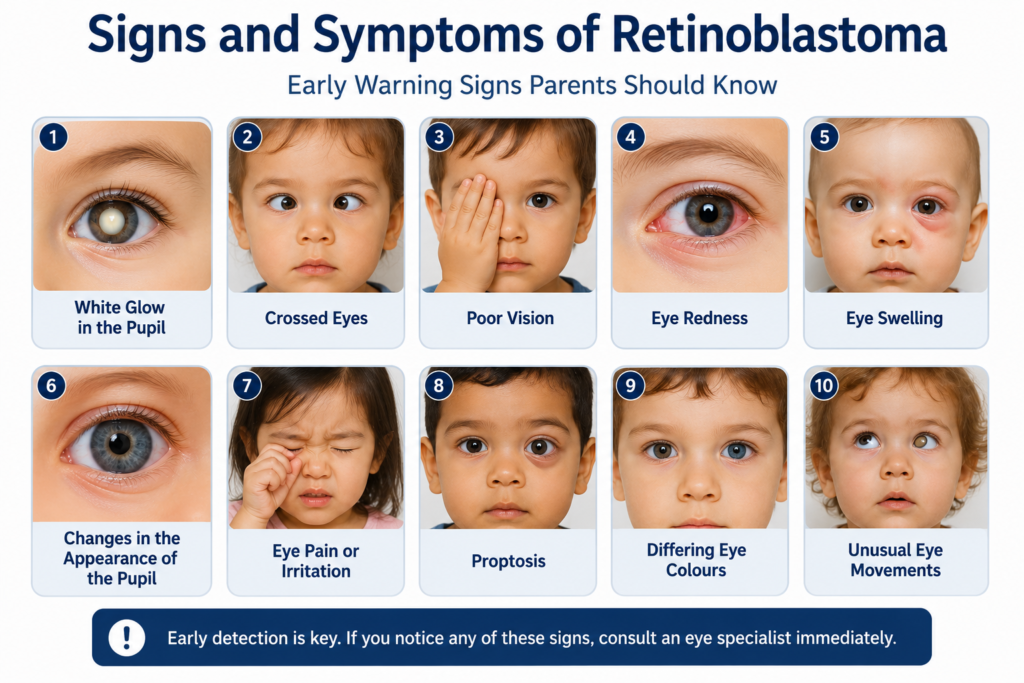
Because Retinoblastoma can affect very young children, it is likely that the patient cannot communicate any visual issues at all. Parents play a crucial role in spotting early symptoms of retinoblastoma since they are the ones who can detect some changes in the appearance of the child’s eyes.
- White Glow in the Pupil
- Crossed Eyes
- Poor Vision
- Eye Redness.
- Eye Swelling
- Changes in the Appearance of the Pupil
- Eye Pain or Irritation
- Proptosis
- Differing Eye Colours
- Unusual Eye Movements
In case any of these signs are identified, it is necessary to see an eye specialist at the earliest for proper diagnosis, since early diagnosis holds great significance in the treatment of retinoblastoma.
Understanding Retinoblastoma Causes
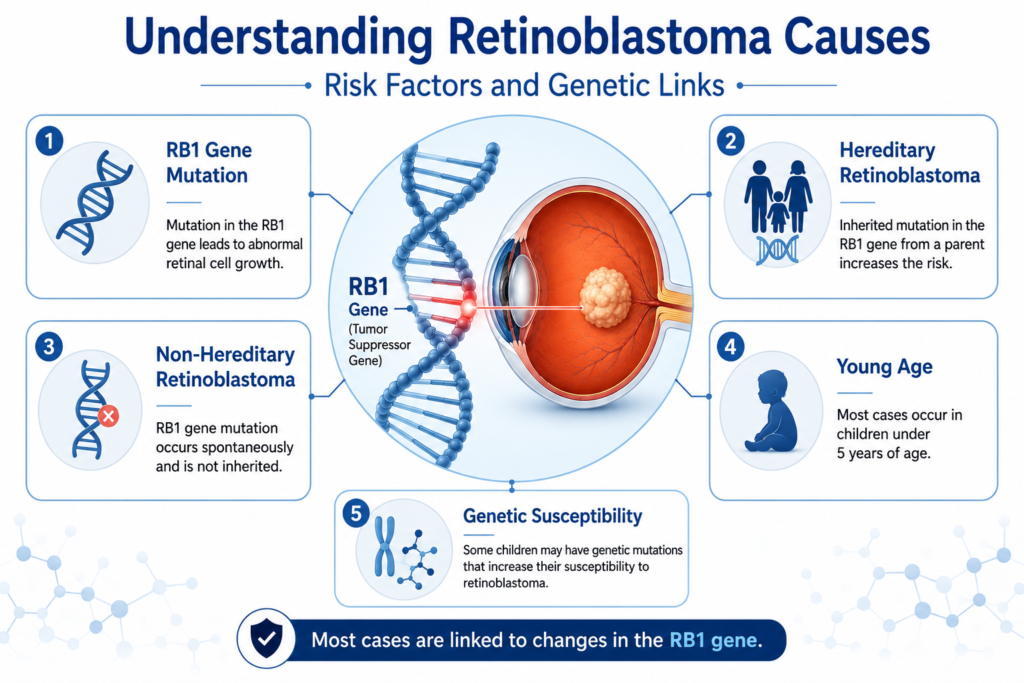
The emergence of retinoblastoma comes from the presence of genetic alterations that lead to the abnormal multiplication of retinal cells. In this regard, the disease is characterised by alterations in the RB1 gene, which is the tumour suppressor gene responsible for controlling the growth of retinal cells.
- Mutation in the RB1 Gene: The main reason for the development of retinoblastoma is a mutation in the RB1 gene responsible for controlling the process of cell division.
- Hereditary Retinoblastoma: Some patients suffer from retinoblastoma caused by an alteration in the RB1 gene, which can be transmitted from a parent. Also, children whose relatives have suffered from retinoblastoma face a higher risk of getting the disease due to genetic predispositions.
- Non-Hereditary Retinoblastoma: In many patients, the alteration of the RB1 gene occurs independently and not due to heredity.
- Young Age: Patients under five years old get retinoblastoma much more often than adults because the disease affects young eyes still forming retinas.
- Genetic Susceptibility: Some children can suffer from genetic mutations that lead to higher risks of retinoblastoma.
Although genetic abnormalities are the major causes of retinoblastoma development, knowledge of these risks can help in identifying children who should be regularly checked by ophthalmologists.
How is Retinoblastoma Diagnosed?
The diagnosis of retinoblastoma entails a range of specialised eye examinations, imaging studies and sometimes even genetic analysis. Because biopsy is usually not recommended due to the potential spread of cancer cells outside the eye, a thorough clinical assessment and special imaging tests have become indispensable methods for diagnosing this serious illness.
- Comprehensive Eye Examination: A complete eye examination carried out by a pediatric ophthalmologist may be considered an important initial step in diagnosing this illness. Pupillodilatation makes it possible to examine the retina and detect the presence, dimensions and location of the tumour. In the case of small children, a comprehensive eye examination should be done under anaesthesia.
- Ocular Ultrasound Scan: This non-invasive procedure helps to form pictures of the internal structures of the eye using sound waves. Ocular ultrasound scan has become the most widely used method to diagnose retinoblastoma. This method helps to establish the exact dimensions and features of the tumour.
- Magnetic Resonance Imaging (MRI): Using a high-strength magnet and radio waves, an MRI scan produces detailed pictures of the eye and its structures, as well as adjacent areas, including the optic nerve. It helps to establish whether the tumour spreads beyond the eye.
- Genetic Testing: Blood or saliva samples can be tested in order to detect mutations of the RB1 gene. This type of diagnostic procedure allows determining whether or not the disease is inherited and gives valuable information to other family members, who might also be affected by the problem.
- Additional Laboratory Testing: For some patients, it might be necessary to perform blood tests and other laboratory analyses in order to assess their general health status and to check whether the tumour has metastasised beyond the eye.
Diagnosis plays an extremely important role in determining the severity of the problem. Correctly made, a diagnosis will allow specialists to analyse the problem in its early stages.
What Are The Retinoblastoma Treatment Options?
Retinoblastoma treatment involves the use of numerous approaches, which vary according to various factors, such as the size and location of the tumour, involvement of a single eye or both, and the progress of the disease. Key objectives of retinoblastoma treatments are the eradication of the cancer and the preservation of the eye and vision, if possible.
- Chemotherapy: It involves administering anti-cancer drugs for the purpose of shrinking or destroying cancer tumours. Chemotherapy is mainly recommended if the retinoblastoma affects a vast part of the retina or both eyes.
- Laser Treatment (Photocoagulation): In laser treatment, the laser beam targets the tumoral blood vessels to destroy them, thereby preventing the growth of the cancer.
- Cryotherapy: This treatment option entails the freezing and destruction of small tumours caused by retinoblastoma in certain locations of the retina.
- Thermotherapy: Here, controlled heat is used to kill cancer cells, normally with the help of infrared radiation.
- Plaque Brachytherapy: The method involves placing a small radioactive plaque near the tumour for the purpose of destroying it.
- External Beam Radiation Therapy: High-energy beams of radiation target the tumour to kill cancer cells if other treatments are not appropriate.
- Enucleation (Removal of Eye through Surgery): In some severe cases where the tumour is large, there is no possibility of saving vision; hence, removal of the damaged eye through surgery might be advised.
- Targeted Chemotherapy & Intra-Arterial Chemotherapy: Some modern techniques involve delivering chemotherapy directly to the eye or even to the arteries of the eye, allowing for a much higher dose of chemicals to affect the tumour and minimising its effect on other organs in the body.
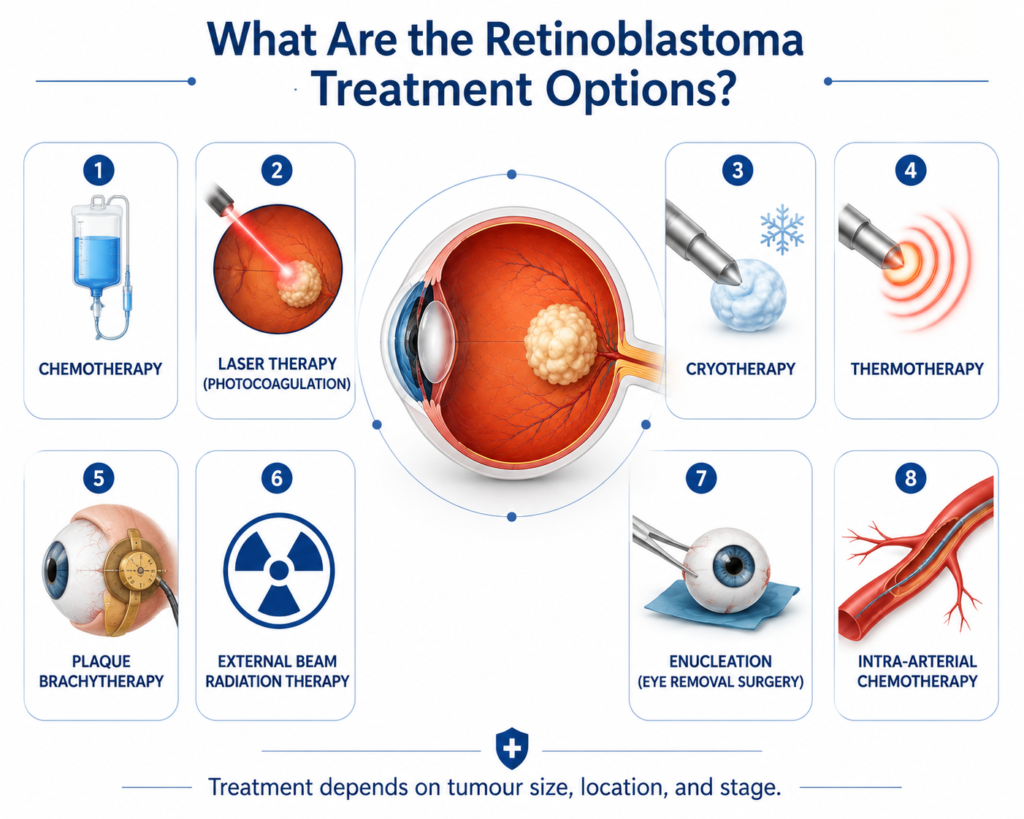
The treatment of retinoblastoma has greatly improved due to advancements in pediatric ophthalmology and oncology. Many patients can experience good results, especially when it is treated early enough.
Why Patients Choose Vasan Eye Dubai for Retinoblastoma Treatment?
The Vasan Eye & Multispeciality DSC places special emphasis on providing quality, specialised, and comprehensive care of the eye in the case of retinoblastoma patients. With a highly experienced medical staff and modern equipment that allows a precise diagnosis, Vasan aims at offering its patients personalised treatment programs tailored specifically for each person.
This is a patient-oriented center, whose medical professionals strive not only to provide effective care for retinoblastoma but also to help each child feel good physically and psychologically. A careful assessment of each patient’s health condition allows for selecting the right course of action to take into account the health condition and provide a favourable result. Thus, it is clear why Vasan Eye & Multispeciality DSC could be considered an ideal place for retinoblastoma treatment in Dubai.
Reach Out for Expert Care
Frequently Asked Questions (FAQs) – Retinoblastoma Treatment in Dubai
1. What is the best treatment for retinoblastoma?
The answer is that there is no universal best treatment for retinoblastoma. The choice of treatment should be determined by such factors as the tumour size, location, stage, whether only one eye or both are involved, and the general condition of the child. Different specialists can recommend any combination of chemotherapy, laser therapy, cryotherapy, radiation therapy, or surgery.
2. Can a child survive retinoblastoma?
Yes. If retinoblastoma is detected early and treatment starts immediately, it has a very good prognosis. Most children with this kind of eye cancer survive and have excellent results.
3. Can retinoblastoma be removed?
Yes. The eye disease called retinoblastoma can be successfully treated and removed by using procedures such as chemotherapy, laser therapy, cryotherapy, or surgery.
4. What is the retinoblastoma treatment cost in Dubai?
The cost of treating retinoblastoma in Dubai depends on various factors, including the stage of cancer, required diagnostics, method of treatment, availability of facilities in the clinic or hospital, and frequency of treatments. Evaluation from an eye specialist will give you an estimate of the cost. However, it usually starts from 23,800 AED (approximately $6,500 USD).
5. Do you lose your eyes with retinoblastoma?
No. Retinoblastoma does not always result in the loss of the eye and its functional ability. However, if the tumour grows extensively, making vision impossible, then removing the diseased eye could be suggested.
6. Can retinoblastoma come back?
Yes. Retinoblastoma has a chance of recurring even after the treatment. It may appear again, especially during the first few years after diagnosis.

Vasan Eye & Multispeciality DSC's Medical Content Team
Vasan Eye & Multispeciality DSC’s medical content team specialises in creating accurate, clear, and patient-focused healthcare content. With strong clinical understanding and expertise in technical writing and SEO, the team translates complex medical information into reliable, accessible resources that support informed decisions and uphold Vasan Eye & Multispeciality DSC’s commitment to quality care.
 WhatsApp